Sleep Owl Day, Party Owl Night!

F/6.3, 1/80, ISO 500.

Eastern Screech-Owl

Why did the Owl invite his friends over?

He didn’t want to be owl by himself.

Interesting Fact: Like most raptors, male Eastern Screech-Owls are smaller than females, and are more agile fliers and hunters. The female doesn’t hunt while on the nest; she and the chicks depend on food brought them by the male. Though the male is smaller, his voice is deeper than the female’s.  ( https://www.allaboutbirds.org/guide/Eastern_Screech-Owl/ )

Snow Fun

Snow Fun

F/8.0, 1/250, ISO 100.

How do you know if there’s a snowman in your bed?

You wake up wet!

Interesting Fact: Snow forms when  water vapor in the atmosphere freezes into ice crystals.


I Have My Goldeneye On You!

F/9.0, 1/320, ISO 160.

Common Goldeneye

Why did the cookie go to the hospital?

He felt crummy!

Interesting Fact: In winter and early spring, male Common Goldeneyes perform a complex series of courtship displays that includes up to 14 moves with names like “masthead,” “bowsprit,” and “head throw kick,” in which the male bends his head back to touch his rump, then thrusts forward and kicks up water with his feet. ( https://www.allaboutbirds.org/guide/Common_Goldeneye/

It’s Not What’s Under The Tree That Matters It’s Who’s Gathered Around It.

F/11.0, 1/500, ISO 400.

Merry Christmas And Happy Holidays To You All!

Why is Santa so jolly?

Because he knows where all the naughty girls live.

Interesting Fact: Modern Christmas trees originated during the Renaissance of early modern Germany. Its 16th-century origins are sometimes associated with Protestant Christian reformer Martin Luther, who is said to have first added lighted candles to an evergreen tree. ( https://en.wikipedia.org/wiki/Christmas_tree )

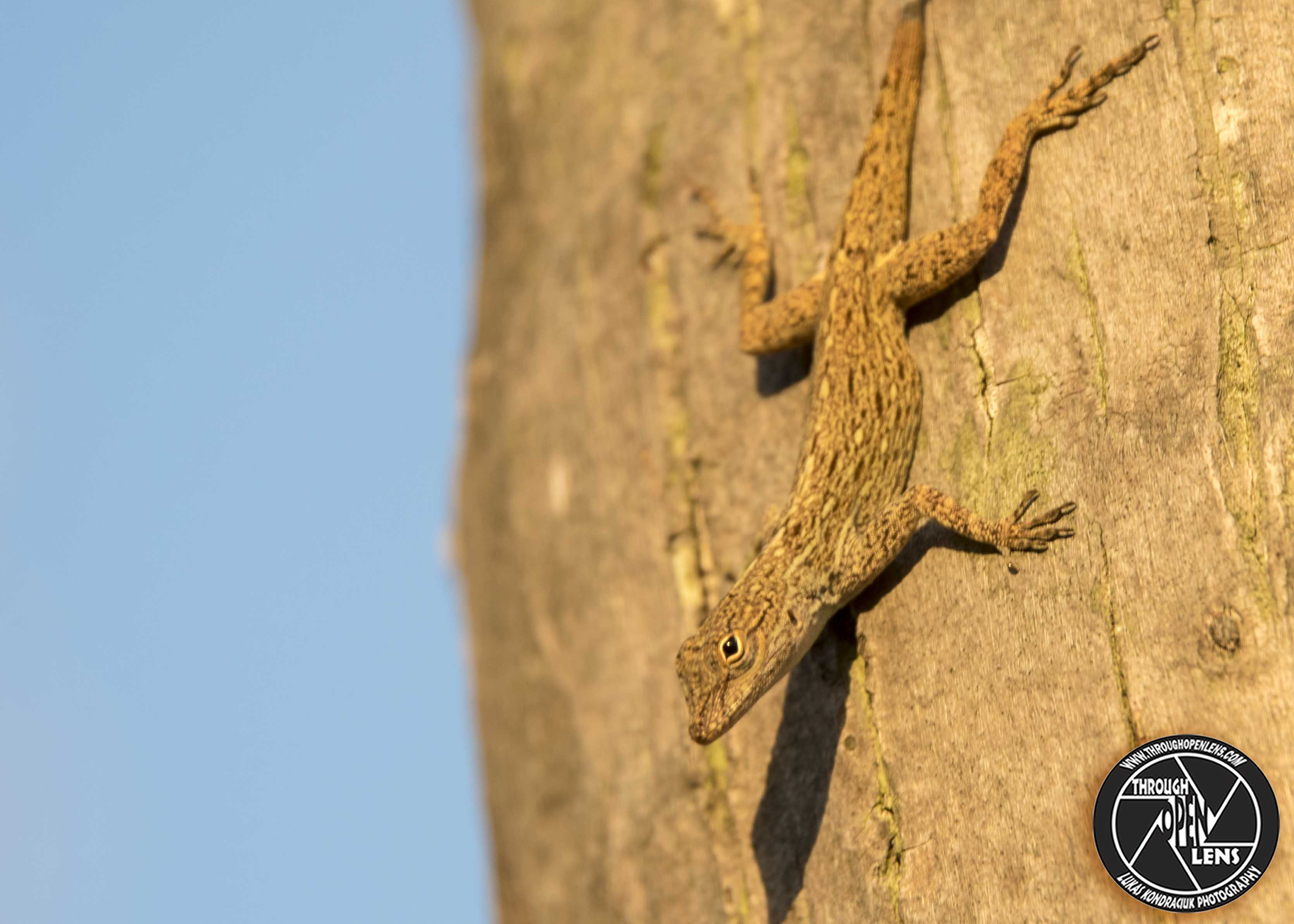
You Are A Lizard Not A Wizard!

F/7.1, 1/200, ISO 125.

Anolis Cristatellus ( Crested Anole ) 

What do you call a lizard that sings for a Rap Records?

A Rap-tile!

Interesting Fact: When looking for a mate or defending its territory, this anole will display its dewlap and perform “push-ups” to establish dominance. Males aggressively defend territories when mating, but only rarely does this result in physical combat. As a defense against predators, they autotomize their tails. ( https://en.wikipedia.org/wiki/Anolis_cristatellus )

Stop, Don’t Move!

black-capped-chickadee

F/9.0, 1/320, ISO 400.

Black-Capped Chickadee

Did you hear about the actor who fell through the floorboards?

He was just going through a stage.

Interesting Fact: Every autumn Black-capped Chickadees allow brain neurons containing old information to die, replacing them with new neurons so they can adapt to changes in their social flocks and environment even with their tiny brains. ( https://www.allaboutbirds.org/guide/Black-capped_Chickadee/lifehistory )

All Bridges Can Be Crossed, So Don’t Give Up!

F/10.0, 1/640, ISO 160.

Verrazano-Narrows Bridge

Why was the big cat disqualified from the race?

Because it was a cheetah.

Interesting Fact: A bridge across the Narrows had been proposed as early as 1927, when structural engineer David B. Steinman brought up the possibility of such a crossing.[3] At the time, Staten Island was isolated from the rest of New York City, and its only direct connection to the other four boroughs was via the Staten Island Ferry to South Ferry in Manhattan, or 39th and 69th Streets in Brooklyn.[4] In 1928, when the chambers of commerce in Brooklyn, Queens, Long Island, and Staten Island announced that the Interboro Bridge Company had proposed the future construction of the “Liberty Bridge” to United States Department of War. The bridge’s towers would be 800 feet (240 m) high and it would cost $60 million in 1928 dollars.[5] In November 1929, engineers released plans for the 4,500-foot (1,400 m) Liberty Bridge spanning the Narrows,[6] with 800-foot-tall towers.[7] It was hoped that the new construction would spur development on Staten Island, along with the Outerbridge Crossing and the Bayonne Bridge, which were under construction at the time. ( https://en.wikipedia.org/wiki/Verrazano-Narrows_Bridge#History

He Tried To Imagine The Sound Of The Color Red

F/8.0, 1/250, ISO 800.

Scarlet Tanager

What happened when the two antennas got married?

Well, the ceremony was kinda boring, but the reception was great!

Interesting Fact: The female Scarlet Tanager sings a song similar to the male’s, but softer, shorter, and less harsh. She sings in answer to the male’s song and while she is gathering nesting material. ( https://www.allaboutbirds.org/guide/Scarlet_Tanager/overview )

Never Wrestle With A Pig. You Both Get Dirty And The Pig Loves It….

F/5.6, 1/100, ISO 320.

Duroc pig

What do you call a pig with no legs?

A groundhog.

Interesting Fact: The Duroc pig is an older breed of domestic pig. The breed was developed in the United States and formed the basis for many mixed-breed commercial hogs.  ( https://en.wikipedia.org/wiki/Duroc_pig )

I Am Not Liable If You Falling Asleep Count Sheep!

F/8.0, 1/250, ISO 320.

Sheep

What do you call a sheep that is always quiet?

A shhhheep!

Interesting Fact: The exact line of descent between domestic sheep and their wild ancestors is unclear.[1] The most common hypothesis states that Ovis aries is descended from the Asiatic (O. orientalis) species of mouflon.[2]:5 Sheep were among the first animals to be domesticated by humankind (although the domestication of dogs may be over 20,000 years earlier); the domestication date is estimated to fall between 11,000 and 9,000 B.C in Mesopotamia.[2]:4[3]:11–14[4]:2[5] The rearing of sheep for secondary products, and the resulting breed development, began in either southwest Asia or western Europe.[6] Initially, sheep were kept solely for meat, milk and skins. Archaeological evidence from statuary found at sites in Iran suggests that selection for woolly sheep may have begun around 6000 BC,[2]:5[3]:11 and the earliest woven wool garments have been dated to two to three thousand years later. ( https://en.wikipedia.org/wiki/Sheep#History )