Kinda Classy Kinda Hood

F/6.3, 1/500, ISO 220.

Hooded Merganser ( Female )

When is a door sweet and tasty?

When it’s jammed!

Interesting Fact: Unlike dabbling ducks, Hooded Mergansers swim low in the water. Their legs are far back on their bodies, which helps in diving but makes them awkward on land. They take flight by running across the water, flying with fast wingbeats and never gliding until they are about to land (by skidding to a stop on the water). ( https://www.allaboutbirds.org/guide/Hooded_Merganser/lifehistory )


Is Your Tail Up For A Reason Or You Just Happy To See Me?!

F/9.0, 1/320, ISO 250.

Ruddy Duck

Why are Christmas trees so bad at sewing?

They always drop their needles!

Interesting Fact:  Unlike most ducks, they form pairs only after arriving on the breeding grounds each year. Males perform unusual courtship displays in which they stick their tails straight up while striking their bills against their inflated necks, creating bubbles in the water as air is forced from their feathers. They punctuate the end of the display with a belch-like call. Courting males also lower their tails and run across the water, making popping sounds with their feet. ( https://www.allaboutbirds.org/guide/Ruddy_Duck/lifehistory )

I Don’t Give A Duck!

F/10.0, 1/400, ISO 250.

Bufflehead Duck male

Why was the snowman looking through the carrots?

He was picking his nose!

Interesting Fact: During the winter, look for these tiny, black-and-white ducks in sheltered coves along the Atlantic or Pacific coast, or on inland ponds in southern North America. While foraging they spend half their time underwater, so scan carefully and patiently. ( https://www.allaboutbirds.org/guide/Bufflehead/ )


Don’t Be Jealous Of My Beak.

F/9.0, 1/320, ISO 640.

Common Loon 

Why is sex like math?

You add a bed, subtract the clothes, divide the legs, and pray there’s no multiplying!

Interesting Fact: A hungry loon family can put away a lot of fish. Biologists estimate that loon parents and their 2 chicks can eat about a half-ton of fish over a 15-week period.  ( https://www.allaboutbirds.org/guide/Common_Loon )

Why The Long Face?

F/6.3, 1/160, ISO 200.

Common Eider 

What did one toilet say to the other toilet?

You look a bit flushed.

Interesting Facts: This species dives for crustaceans and molluscs, with mussels being a favoured food. The eider will eat mussels by swallowing them whole; the shells are then crushed in their gizzard and excreted. When eating a crab, the eider will remove all of its claws and legs, and then eat the body in a similar fashion. ( https://en.wikipedia.org/wiki/Common_eider )

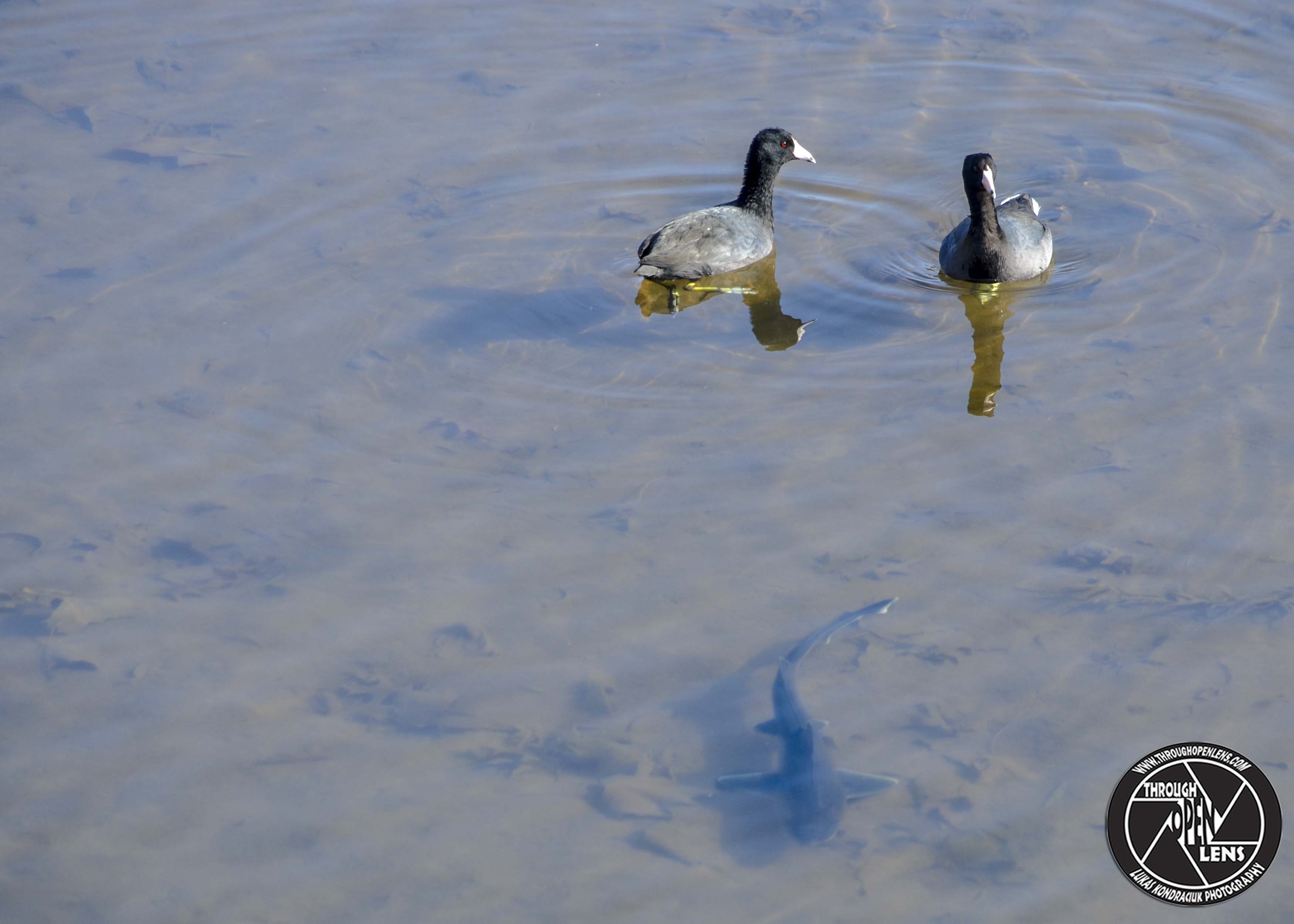
Duuun-Dunn-Dunn-Duh-Duh-Duh-Nuh-Nuh-Nuh-Nuuh!!!

F/5.6, 1/500, ISO 250.

Shark Week 

American Coot

Spiny Dogfish Shark

Why do sharks make terrible lawyers?

They’re too nice!

Interesting Fact: Although it swims like a duck, the American Coot does not have webbed feet like a duck. Instead, each one of the coot’s long toes has broad lobes of skin that help it kick through the water. The broad lobes fold back each time the bird lifts its foot, so it doesn’t impede walking on dry land, though it supports the bird’s weight on mucky ground. ( https://www.allaboutbirds.org/guide/American_Coot )

I Fear Sharks So Much That I Just Sharted!

F/6.3, 1/640, ISO 7200.

Pied-Billed Grebe

Why do sharks make terrible lawyers?

They’re too nice!

Interesting Fact: Pied-billed Grebe chicks typically leave the nest the first day after hatching and spend much of their first week riding around on a parent’s back. They usually spend most of their first 3 weeks on or near the nest platform. ( https://www.allaboutbirds.org/guide/Pied-Billed_Grebe )

In A World Full Of Fish Be A Shark

Shark Week 

F/5.6, 1/500, ISO 360.

Spiny Dogfish Shark

What did the seal with the broken arm say to the shark?

Do not consume if seal is broken.

Interesting Fact: This shark is known to hunt in packs that can range up into the thousands. They are aggressive hunters and have a sizable diet that can range from squid, fish, crab, jellyfish, sea cucumber, shrimp and other invertebrates. ( https://en.m.wikipedia.org/wiki/Spiny_dogfish )

I Have My Goldeneye On You!

F/9.0, 1/320, ISO 160.

Common Goldeneye

Why did the cookie go to the hospital?

He felt crummy!

Interesting Fact: In winter and early spring, male Common Goldeneyes perform a complex series of courtship displays that includes up to 14 moves with names like “masthead,” “bowsprit,” and “head throw kick,” in which the male bends his head back to touch his rump, then thrusts forward and kicks up water with his feet. ( https://www.allaboutbirds.org/guide/Common_Goldeneye/

I Trying To Get My Duck In The Row But I Got Geese Instead!

F/7.1, 1/200, ISO 250.

Canada Goose and Goslings

What did the triangle say to the circle?

Your pointless!

Interesting Fact:  In spring and summer, geese concentrate their feeding on grasses and sedges, including skunk cabbage leaves and eelgrass. During fall and winter, they rely more on berries and seeds, including agricultural grains, and seem especially fond of blueberries. They’re very efficient at removing kernels from dry corn cobs. Two subspecies have adapted to urban environments and graze on domesticated grasses year round. ( https://www.allaboutbirds.org/guide/Canada_Goose/lifehistory )