I Claim This Rock!

F/5.6, 1/250, ISO 800.

Muskrat

Why did the cookie go to the hospital?

He felt crummy!

Interesting Fact: Muskrats are most active at night or near dawn and dusk. They feed on cattails and other aquatic vegetation. They do not store food for the winter, but sometimes eat the insides of their push-ups. While they may appear to steal food beavers have stored, more seemingly cooperative partnerships with beavers exist, as featured in the BBC David Attenborough wildlife documentary The Life of Mammals.[22][23] Plant materials compose about 95% of their diets, but they also eat small animals, such as freshwater mussels, frogs, crayfish, fish, and small turtles.[5][6] Muskrats follow trails they make in swamps and ponds. When the water freezes, they continue to follow their trails under the ice. ( https://en.wikipedia.org/wiki/Muskrat#Behavior )

Giggity, Giggity, Quack!

F/11.0, 1/500, ISO 500.

Ruddy Duck

What did the calculator say to the cashier?

You can count on me.

Interesting Fact:  Most males pair up with one female each for the duration of the breeding season, but some take multiple mates. Their eggs are proportionally the largest of all waterfowl. The ducklings hatch well-developed and active, receiving minimal care from the mother and none from the father. ( https://www.allaboutbirds.org/guide/Ruddy_Duck/lifehistory )

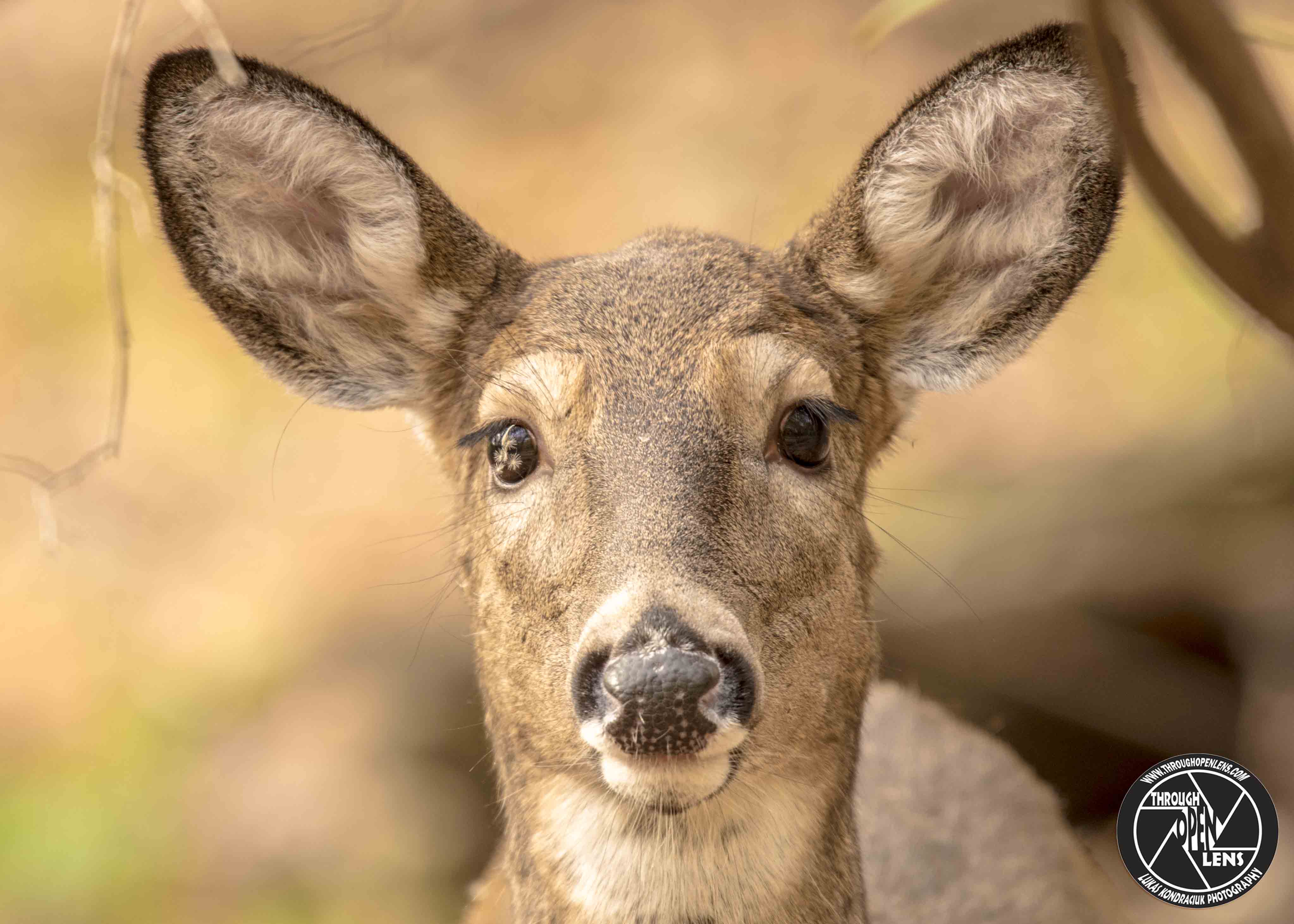
Hi I Exist!

F/6.3, 1/80, ISO400.

White-Tailed Deer

Who won the skeleton beauty contest?

Nobody.

Interesting Fact: The conversion of land adjacent to the Canadian Rockies into agriculture use and partial clear-cutting of coniferous trees (resulting in widespread deciduous vegetation) has been favorable to the white-tailed deer and has pushed its distribution to as far north as Yukon. Populations of deer around the Great Lakes have also expanded their range northwards, due to conversion of land to agricultural uses favoring more deciduous vegetation, and local caribou and moose populations. The westernmost population of the species, known as the Columbian white-tailed deer, once was widespread in the mixed forests along the Willamette and Cowlitz River valleys of western Oregon and southwestern Washington, but today its numbers have been considerably reduced, and it is classified as near-threatened. This population is separated from other white-tailed deer populations. ( https://en.wikipedia.org/wiki/White-tailed_deer )


Does Running Late Count As Exercise?

F/9.0, 1/320, ISO 160.

Gray Kingbird

What do bulls do when they go shopping?

They CHARGE!

Interesting Fact: Gray kingbirds wait on an exposed perch high in a tree, occasionally sallying out to feed on insects, their staple diet. ( https://en.wikipedia.org/wiki/Gray_kingbird  )

You Never Realize How Boring Your Life Is Until Someone Asks What You Like To Do For Fun.

F/9.0, 1/320, ISO 160.

Palmchat

What happened to the wooden car with wooden wheels and wooden engine?

It wooden go!

Interesting Fact: The species is endemic to the island of Hispaniola (Haiti and the Dominican Republic), including the adjacent Saona and Gonâve Islands, where it is common and widespread. It inhabits areas from sea-level to 1500 m asl where palm savannas can be found, or other open areas with scattered trees. Where its food trees are present, it has adapted well to city parks and gardens. ( https://en.wikipedia.org/wiki/Palmchat )

Mine! Mine! Mine! Mine! Mine! Mine!

ring-billed-gulls

F/5.6, 1/320, ISO 400.

Ring-billed Gull             

What do you call a man with seagull on his head?

Cliff

Interesting Fact: Migrating Ring-billed Gulls apparently use a built-in compass to navigate. When tested at only two days of age, chicks showed a preference for magnetic bearings that would take them in the appropriate direction for their fall migration. The gulls also rely on landmarks and high-altitude winds to provide directional cues.  ( https://www.allaboutbirds.org/guide/Ring-billed_Gull/lifehistory )

You Give Me Goosebumps!

F/6.3, 1/640, ISO 160.

Greylag goose

What concert costs 45 cents?

50 Cent featuring Nickleback.

Interesting Fact: Greylag geese are gregarious birds and form flocks. This has the advantage for the birds that the vigilance of some individuals in the group allows the rest to feed without having to constantly be alert to the approach of predators. After the eggs hatch, some grouping of families occur, enabling the geese to defend their young by their joint actions, such as mobbing or attacking predators.[17] After driving off a predator, a gander will return to its mate and give a “triumph call”, a resonant honk followed by a low-pitched cackle, uttered with neck extended forward parallel with the ground. The mate and even unfledged young reciprocate in kind. ( https://en.wikipedia.org/wiki/Greylag_goose#Behaviour   )

Eat My Shorts, Dude!

F/7.1, 1/200, ISO 320.

Common Grackle 

Why do golfers wear two pairs of pants?

In case they get a hole in one!

Interesting Fact: Grackles have a hard keel on the inside of the upper mandible that they use for sawing open acorns. Typically they score the outside of the narrow end, then bite the acorn open. ( https://www.allaboutbirds.org/guide/Common_Grackle/lifehistory )

Bottoms Up!

F/9.0, 1/320, ISO 250.

Killdeer

What did the apple tree say to the farmer?

STOP PICKING ON ME!

Interesting Fact:  The male and female of a mated pair pick out a nesting site through a ritual known as a scrape ceremony. The male lowers his breast to the ground and scrapes a shallow depression with his feet. The female then approaches, head lowered, and takes his place. The male then stands with body tilted slightly forward, tail raised and spread, calling rapidly. Mating often follows. ( https://www.allaboutbirds.org/guide/Killdeer )

Always Stretch Before Swimming!

F/11.0, 1/500, ISO 500.

Ruddy Duck

What is crazy and walks along the sides of buildings?

A walnut.

Interesting Fact: Ruddy Ducks are very aggressive toward each other and toward other species, especially during the breeding season. Unlike most ducks, they form pairs only after arriving on the breeding grounds each year. ( https://www.allaboutbirds.org/guide/Ruddy_Duck/lifehistory )