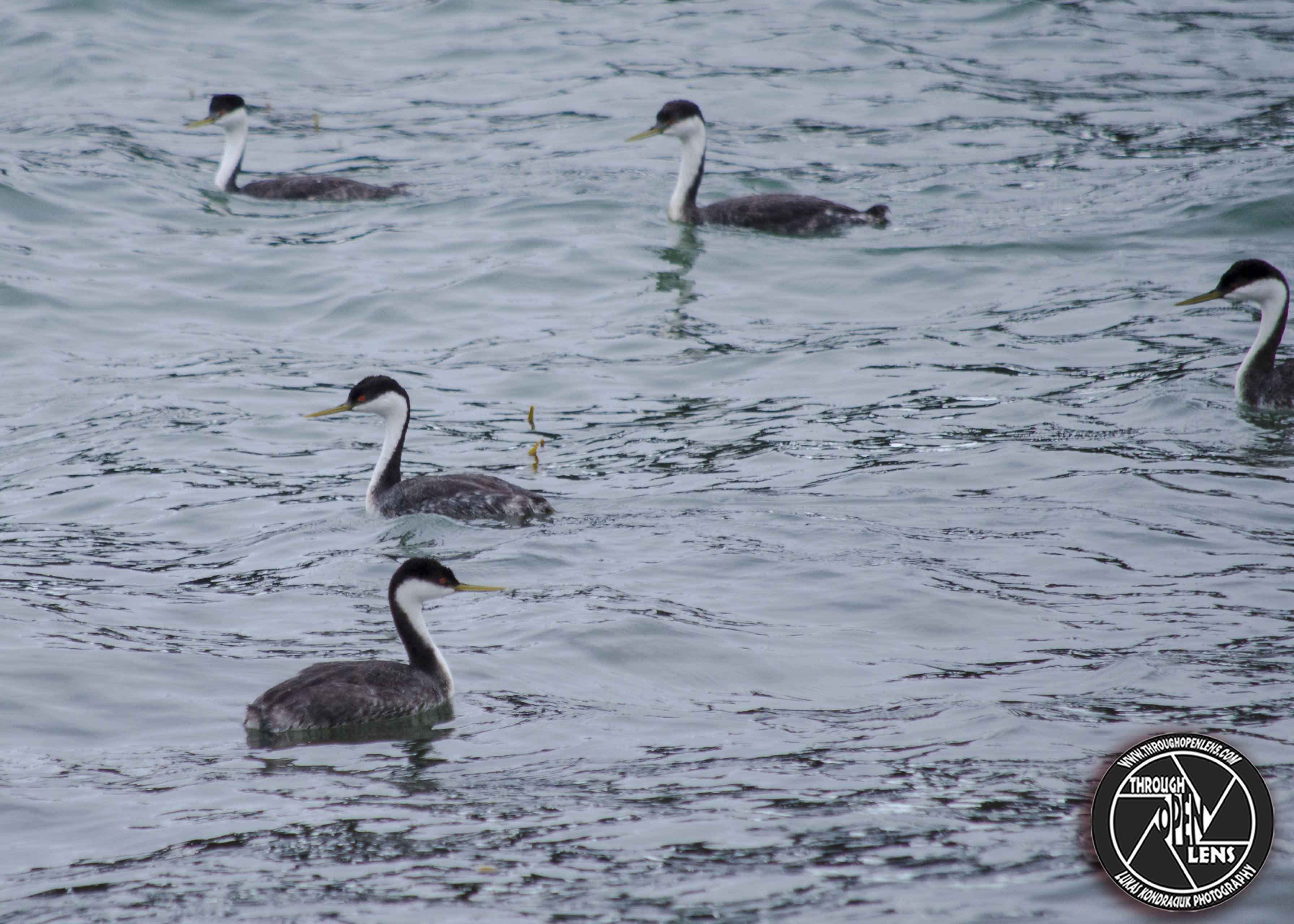
Be Different!

F/5.6, 1/500, ISO 360.

Western-Grebe

Why did the traffic light turn red?

You would too if you had to change in the middle of the street!

Interesting Fact:  The Western Grebe, like other grebes, spends almost all its time in water and is very awkward when on land. The legs are so far back on the body that walking is very difficult. Western Grebes are adept swimmers and divers. Courtship happens entirely in the water, including a well-known display known as “rushing,” where two birds turn to one side, lunge forward in synchrony, their bodies completely out of the water, and race across the water side by side with their necks curved gracefully forward. ( https://www.allaboutbirds.org/guide/Western_Grebe/lifehistory )

Where Does The Itch Goes After You Scratch It?

canada-goose-itch

F/6.3, 1/640, ISO 200.

Canada Goose

What do you call a pig that does karate?

A pork chop.

Interesting Fact: Some migratory populations of the Canada Goose are not going as far south in the winter as they used to. This northward range shift has been attributed to changes in farm practices that makes waste grain more available in fall and winter, as well as changes in hunting pressure and changes in weather. ( https://www.allaboutbirds.org/guide/Canada_Goose/lifehistory )

I’m Sorry I Offended You Whith My Common Sense

F/8.0, 1/250, ISO 250.

Common Murre

Where do polar bears vote?

The North Poll.

Interesting Fact:  In the Atlantic, some populations include “bridled” or “ringed” individuals, which have a white eye-ring and a white line extending backward from the eyes. Bridled birds are more common farther north. ( https://www.allaboutbirds.org/guide/Common_Murre/overview )

My Spirit Animals Is Grey Goose!

F/5.6, 1/800, ISO 160.

Greylag goose

How do you make an egg-roll?

You push it!!!

Interesting Fact: Young greylags stay with their parents as a family group, migrating with them in a larger flock, and only dispersing when the adults drive them away from their newly established breeding territory the following year.[18] At least in Europe, patterns of migration are well understood and follow traditional routes with known staging sites and wintering sites. The young learn these locations from their parents which normally stay together for life. ( https://en.wikipedia.org/wiki/Greylag_goose#Behaviour )

I’m Not Perfect But My Eyeliner Is

F/10.0,1/400, ISO 320.

Green-Winged Teal

Why is Basketball such a messy sport?

Because you dribble on the floor!

Interesting Fact: Green-winged Teal sometimes switch wintering sites from year to year. One banding study found that individuals wintering in Texas one year went as far away as California in subsequent years. This lack of philopatry, or “faithfulness” to a particular site, may reflect the tendency of males that did not breed the year before to try to find mates among a different set of wintering females. ( https://www.allaboutbirds.org/guide/Green-winged_Teal/lifehistory )

I Claim This Rock!

F/5.6, 1/250, ISO 800.

Muskrat

Why did the cookie go to the hospital?

He felt crummy!

Interesting Fact: Muskrats are most active at night or near dawn and dusk. They feed on cattails and other aquatic vegetation. They do not store food for the winter, but sometimes eat the insides of their push-ups. While they may appear to steal food beavers have stored, more seemingly cooperative partnerships with beavers exist, as featured in the BBC David Attenborough wildlife documentary The Life of Mammals.[22][23] Plant materials compose about 95% of their diets, but they also eat small animals, such as freshwater mussels, frogs, crayfish, fish, and small turtles.[5][6] Muskrats follow trails they make in swamps and ponds. When the water freezes, they continue to follow their trails under the ice. ( https://en.wikipedia.org/wiki/Muskrat#Behavior )

Giggity, Giggity, Quack!

F/11.0, 1/500, ISO 500.

Ruddy Duck

What did the calculator say to the cashier?

You can count on me.

Interesting Fact:  Most males pair up with one female each for the duration of the breeding season, but some take multiple mates. Their eggs are proportionally the largest of all waterfowl. The ducklings hatch well-developed and active, receiving minimal care from the mother and none from the father. ( https://www.allaboutbirds.org/guide/Ruddy_Duck/lifehistory )

Mine! Mine! Mine! Mine! Mine! Mine!

ring-billed-gulls

F/5.6, 1/320, ISO 400.

Ring-billed Gull             

What do you call a man with seagull on his head?

Cliff

Interesting Fact: Migrating Ring-billed Gulls apparently use a built-in compass to navigate. When tested at only two days of age, chicks showed a preference for magnetic bearings that would take them in the appropriate direction for their fall migration. The gulls also rely on landmarks and high-altitude winds to provide directional cues.  ( https://www.allaboutbirds.org/guide/Ring-billed_Gull/lifehistory )

You Give Me Goosebumps!

F/6.3, 1/640, ISO 160.

Greylag goose

What concert costs 45 cents?

50 Cent featuring Nickleback.

Interesting Fact: Greylag geese are gregarious birds and form flocks. This has the advantage for the birds that the vigilance of some individuals in the group allows the rest to feed without having to constantly be alert to the approach of predators. After the eggs hatch, some grouping of families occur, enabling the geese to defend their young by their joint actions, such as mobbing or attacking predators.[17] After driving off a predator, a gander will return to its mate and give a “triumph call”, a resonant honk followed by a low-pitched cackle, uttered with neck extended forward parallel with the ground. The mate and even unfledged young reciprocate in kind. ( https://en.wikipedia.org/wiki/Greylag_goose#Behaviour   )

Bottoms Up!

F/9.0, 1/320, ISO 250.

Killdeer

What did the apple tree say to the farmer?

STOP PICKING ON ME!

Interesting Fact:  The male and female of a mated pair pick out a nesting site through a ritual known as a scrape ceremony. The male lowers his breast to the ground and scrapes a shallow depression with his feet. The female then approaches, head lowered, and takes his place. The male then stands with body tilted slightly forward, tail raised and spread, calling rapidly. Mating often follows. ( https://www.allaboutbirds.org/guide/Killdeer )