Do Not Cross Me I Have My Fancy Pants On Today!

F/5.6, 1/500, ISO 200.

Snowy Egret

What did the triangle say to the circle?

You are pointless!

Interesting Fact: Male Snowy Egrets fight for breeding territories, choose nest sites, and perform noisy courtship displays to attract mates. A ring of other egrets often gathers around a displaying male as he pumps his body up and down, points his bill skyward, and calls. He also performs aerial displays, including one that ends with him dropping toward the ground while tumbling around and around. After pairing up, Snowy Egrets continue defending the immediate area around the nest, raising their crests and giving rasping calls. Some of their nest predators include raccoons, Great Horned Owls, Barred Owls, American Crows, Fish Crows, American alligators, and gray rat snakes. Highly social all year long, Snowy Egrets forage with gulls, terns, ibises, and other herons, and they nest in colonies alongside many other species, including Great Egrets, night-herons, Glossy Ibises, Little Blue Herons, Tricolored Herons, Cattle Egrets, and Roseate Spoonbills. ( https://www.allaboutbirds.org/guide/Snowy_Egret/lifehistory )

If You’re Feeling Blue Try Painting Yourself A Different Color

F/6.3, 1/160, ISO 1000.

Eastern Bluebird

What starts with a P, ends with an E, and has a million letters in it?

Post Office!

Interesting Fact: The male Eastern Bluebird displays at his nest cavity to attract a female. He brings nest material to the hole, goes in and out, and waves his wings while perched above it. That is pretty much his contribution to nest building; only the female Eastern Bluebird builds the nest and incubates the eggs.  ( https://www.allaboutbirds.org/guide/Eastern_Bluebird/lifehistory )

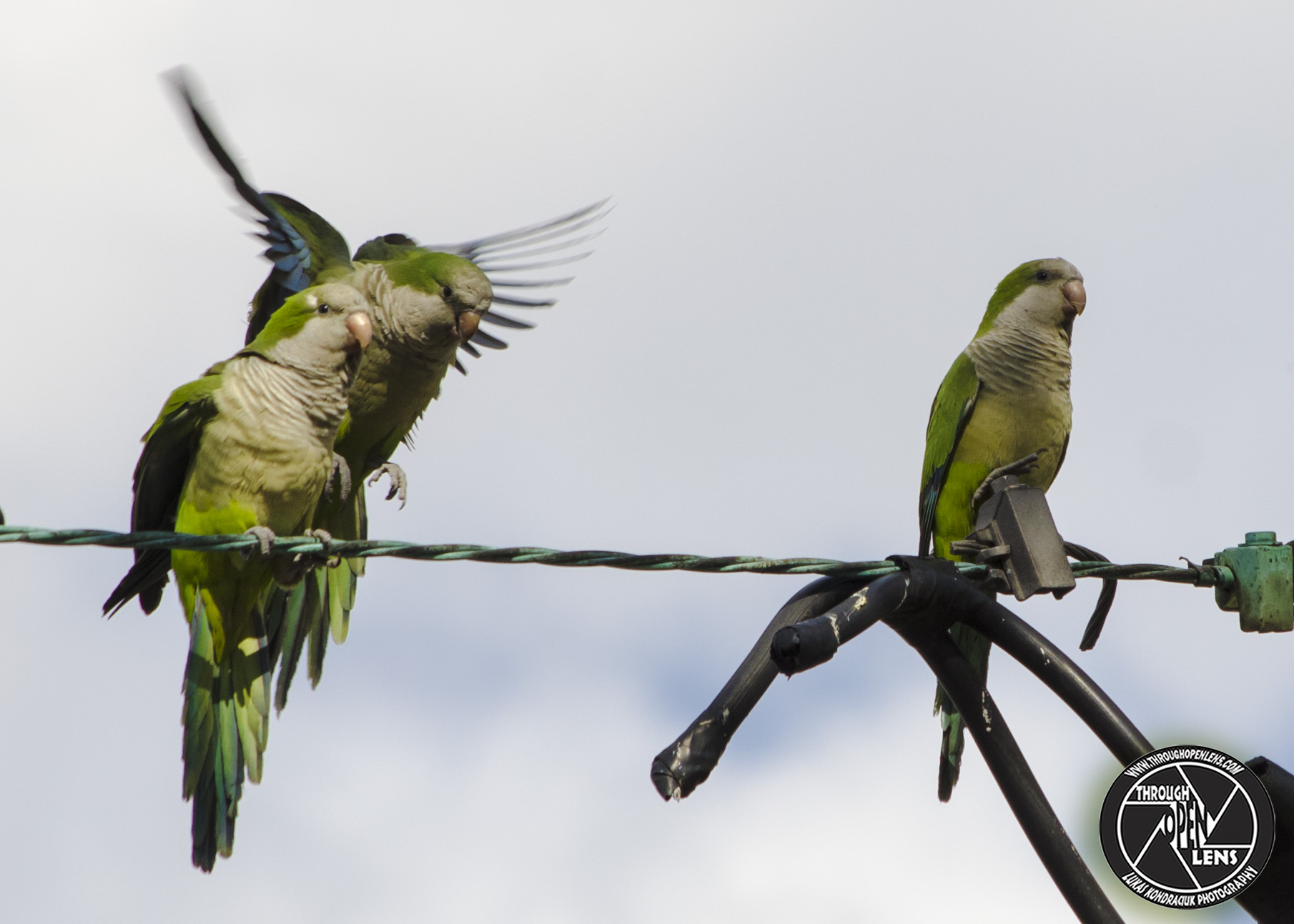
It’s Electrifyin

F/8.0, 1/1000, ISO 200.

Monk Parakeets

What do you get when you cross a parrot and a centipede?

A walkie-talkie.

Interesting Fact: Monk Parakeets in North America live in urban and suburban environments, especially around city parks. They are one of the few parrot species able to survive temperate-zone winters. In their native range in South America, Monk Parakeets live in dry savannas with scattered woods up to about 6,000 feet elevation.  ( https://www.allaboutbirds.org/guide/Monk_Parakeet/lifehistory )

I Claim This Branch!

F/7.1, 1/200, ISO 200.

Eastern Phoebe 

Why can’t you take a nap during a race?

Because if you snooze, you loose!

Interesting Fact: The Eastern Phoebe is a loner, rarely coming in contact with other phoebes. Even members of a mated pair do not spend much time together. They may roost together early in pair formation, but even during egg laying the female frequently chases the male away from her. ( https://www.allaboutbirds.org/guide/Eastern_Phoebe/lifehistory )

Oh Stop, You Making Me Blush!

F/6.3, 1/160, ISO 500.

House Finch

What did one hat say to another? 

You stay here, I’ll go on a head.

Interesting Fact: House Finches nest in a variety of deciduous and coniferous trees as well as on cactus and rock ledges. They also nest in or on buildings, using sites like vents, ledges, street lamps, ivy, and hanging planters. Occasionally House Finches use the abandoned nests of other birds. ( https://www.allaboutbirds.org/guide/House_Finch/lifehistory )

Holy Smokes Batman Your Zipper Is Down!

F/9.0, 1/320, ISO 250.

American Robin

What happens when Batman and Robin fight a steamroller?

They become Flatman and Ribbon.

Interesting Fact: Although robins are considered harbingers of spring, many American Robins spend the whole winter in their breeding range. But because they spend more time roosting in trees and less time in your yard, you’re much less likely to see them. The number of robins present in the northern parts of the range varies each year with the local conditions. ( https://www.allaboutbirds.org/guide/American_Robin/lifehistory )

Here I Sit Broken Hearted Tried To Poop But Only Farted

F/9.0, 1/320, ISO 500.

Yellow-Rumped Warbler

Why did Bob throw the clock out of the window?

Because he wanted to see time fly!

Interesting Fact: Yellow-rumped Warblers flit through the canopies of coniferous trees as they forage. They cling to the bark surface to look for hidden insects more than many warblers do, but they also frequently sit on exposed branches and catch passing insects like a flycatcher does. ( https://www.allaboutbirds.org/guide/Yellow-rumped_Warbler/lifehistory )

Which Way Do We Go?

F/9.0, 1/320, ISO 320.

Ruddy Ducks

Where do sheep go to get haircuts?

To the Baa Baa shop!

Interesting Fact: Ruddy Ducks spend the vast majority of their time on the water. They are fast fliers but have little maneuverability in the air, and they tend to swim and dive rather than fly to escape predators—which include Red-tailed Hawks, Great Horned Owls, mink, raccoons, and red foxes.  ( https://www.allaboutbirds.org/guide/Ruddy_Duck/lifehistory )

When I Am Knocking, You Better Open Up!

F/9.0, 1/320, ISO 250.

Red-Bellied Woodpecker

A police officer caught two kids playing with a firework and a car battery.

He charged one and let the other one off.

Interesting Fact: A Red-bellied Woodpecker can stick out its tongue nearly 2 inches past the end of its beak. The tip is barbed and the bird’s spit is sticky, making it easier to snatch prey from deep crevices. Males have longer, wider-tipped tongues than females, possibly allowing a breeding pair to forage in slightly different places on their territory and maximize their use of available food.  ( https://www.allaboutbirds.org/guide/Red-bellied_Woodpecker/lifehistory )

Being Small Works For Me!

F/5.6, 1/500, ISO 220.

Least Sandpiper

Why did the teddy bear say no to dessert?

Because he was stuffed.

Interesting Fact: The Least Sandpiper is the smallest shorebird in the world, weighing in at about 1 ounce and measuring 5-6 inches long. Males are slightly smaller than females. ( https://www.allaboutbirds.org/guide/Least_Sandpiper )