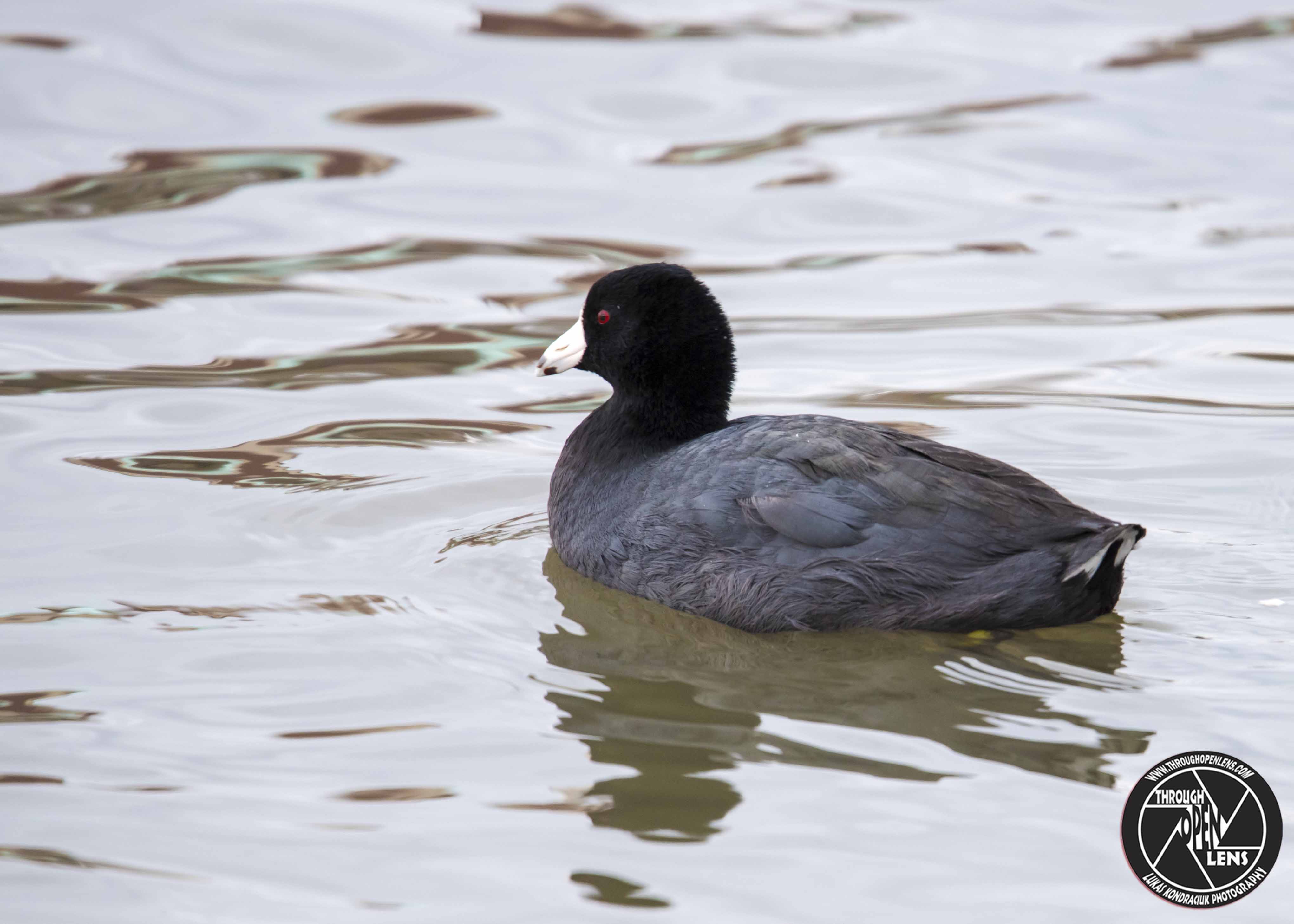
Chill’ ‘Be Cool!

F/6.3, 1/125, ISO 500.

American Coot

Can February march?

No, but April may.

Interesting Fact: The American coot is a highly gregarious species, particularly in the winter, when its flocks can number in the thousands.[20] When swimming on the water surface, American coots exhibit a variety of interesting collective formations, including single-file lines, high density synchronized swimming and rotational dynamics, broad arcing formations, and sequential take-off dynamics. ( https://en.wikipedia.org/wiki/American_coot#Behavior

Let’s Swim Away Together!

F/9.0, 1/320, ISO 200.

Wood Ducks

A man and a woman have just had their 50th wedding anniversary.

The husband turns to his wife and asks, “What do you want to do to celebrate our anniversary dear?”

She replies, “Let’s run upstairs and make love.”

He turns to her and says, “Well make up your mind, we can’t do both!”

Interesting Fact: Egg-dumping, or “intraspecific brood parasitism” is common in Wood Ducks—females visit other Wood Duck cavities, lay eggs in them, and leave them to be raised by the other female. This may have been made more common by the abundance and conspicuousness of artificial nest boxes; in some areas it happens in more than half of all nests. Individual females typically lay 10-11 eggs per clutch, but some very full nests have been found containing 29 eggs, the result of egg-dumping. ( https://www.allaboutbirds.org/guide/Wood_Duck/lifehistory#behavior )

Duck You!

F/8.0, 1/250, ISO 800.

Harlequin Duck Female

At what time does a duck wake up?

At the quack of dawn.

Interesting Fact:  More than half of eastern North American population of Harlequin Ducks winters in coastal Maine, particularly outer reaches of Penobscot and Jericho bays. ( https://www.allaboutbirds.org/guide/Harlequin_Duck/lifehistory )

Keep Going Everything You Need Will Come To You At The Perfect Time.

Happy International Women’s Day

F/11.0, 1/500, ISO 250.

Horned Grebe

What did the man say to the wall?

One more crack like that and I’ll plaster ya!

Interesting Fact: A sleeping or resting Horned Grebe puts its neck on its back with its head off to one side and facing forward. It keeps one foot tucked up under a wing and uses the other one to maneuver in the water. Having one foot up under a wing makes it float with one “high” side and one “low” side.  ( https://www.allaboutbirds.org/guide/Horned_Grebe/lifehistory )

How To Say Happy Women’s Day in Different Languages.

English

Happy Women’s Day

Polish

Szczęśliwy Dzień Kobie

Espanol

Feliz Día de la Mujer

Arabic

وم المرأة العالمي

Italian

Felice Giorno delle Donne

German

Alles Gute zum Tag der Frauen

Portuguese

Feliz Dia Da Mulher

Swedish

Glad kvinnors dag

Hindi

mahila divas kee shubhakaamanae

Korean

yeoseong-ui nal-eul chugha haeyo

Spanish

Feliz Día de la Mujer

Ukrainian

Поздравляю тебя с восьмым марта

French

Bonne Journée de la Femme

Russian

С Международным женским днем [S Mezhdunarodnym zhenskim dnem]

Malayalam

vanitā dinattinṟe santēāṣaṁ

Kannada

Mahileyara Dinada Shubhashayagalu

Telugu

Mahiḷa dinōtsava śubhākāṅkṣalu

Gujarati

Khuśa mahilā divasa

Bangla

Śubha nārī dibasa

Urdu

یوم خواتین مبارک

Chinese

妇女节快乐 [fù nǚ jié kuài lè]

Persian

روز زن مبارک

Turkish

Kadınlar günün kutlu olsun!

Greek

Ευτυχισμένη η ημέρα της γυναίκας

Japanese

Kokusai josei day

We Are Rolling Deep Today!

F/8.0, 1/250, ISO 320.

Ring-necked Duck

Why don`t ducks tell jokes when they fly?

Because they would quack up!

Interesting Fact: Ring-necked Ducks breed in northern North America and spend winters in southern and western North America, northern Central America, and the Caribbean, often on freshwater. Much of the population migrates from central Canada to the southeastern United States, staging along the way in Minnesota and other parts of the upper Midwest.  ( https://www.allaboutbirds.org/guide/Ring-necked_Duck/maps-range

It’s Your Hair Do Whatever You Want!

F/6.3, 1/500, ISO 200.

Hooded Merganser ( Female )

How do ducks talk?

They don’t You Quack.

Interesting Fact: The female chooses the nest site, and may start scouting for next year’s tree cavity at the end of each breeding season. Nest cavities can be in live or dead trees and are usually close to water. Cavities are typically 10–50 feet off the ground, up to about 90 feet. Hooded Mergansers nest readily in boxes, preferring those with wood shavings or nest material from previous uses. They prefer cavities with 3–5 inch openings. ( https://www.allaboutbirds.org/guide/Hooded_Merganser/lifehistory

My Nose Has Done More Running This Winter Than I Have.

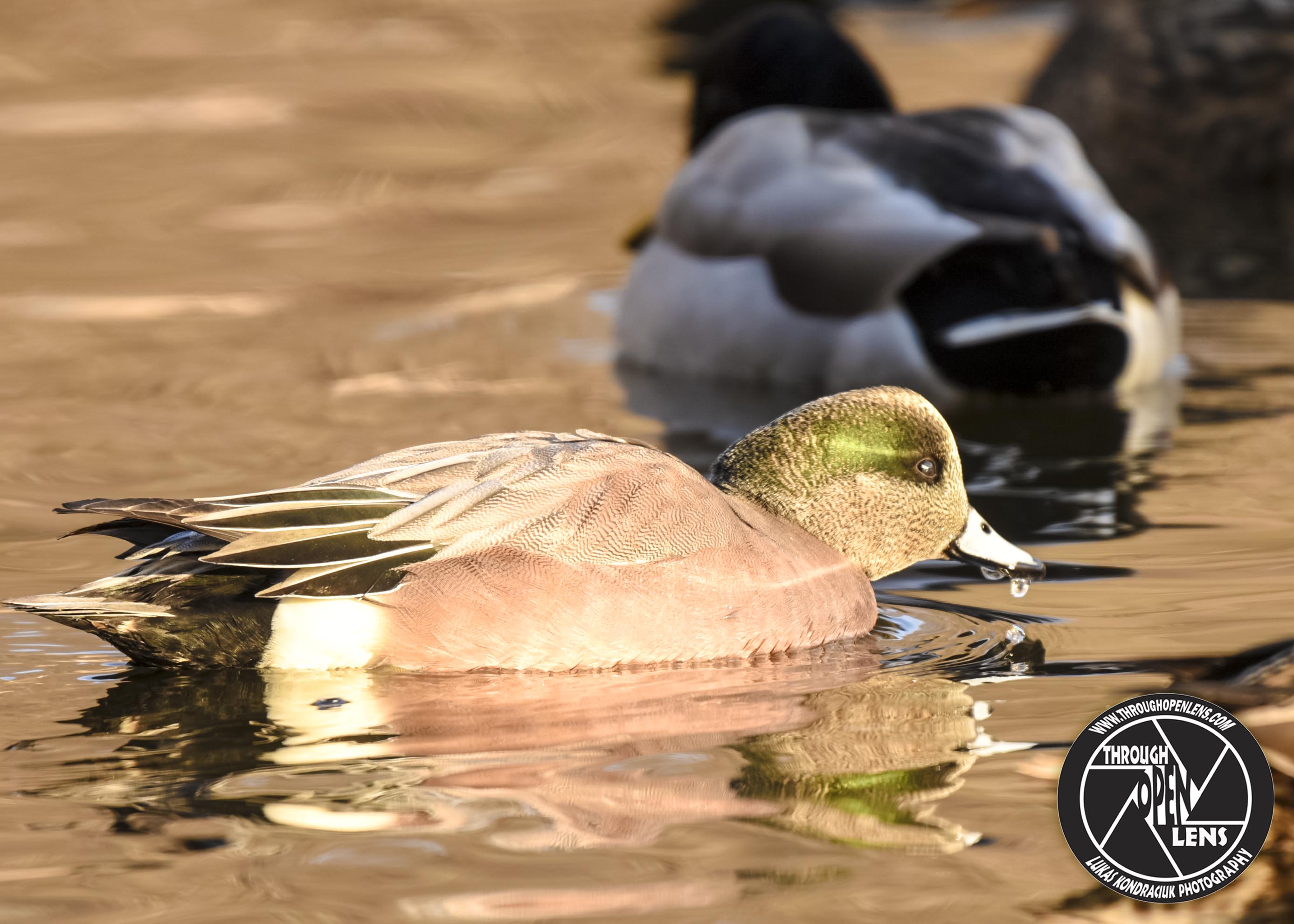
american-wigeon

F/7.1, 1/200, ISO 320.

American Wigeon

I went to a really emotional wedding over the weekend.

Even the cake was in tiers.

Interesting Fact: The American Wigeon’s short bill enables it to exert more force at the bill tip than other dabbling ducks, thus permitting efficient dislodging and plucking of vegetation.  ( https://www.allaboutbirds.org/guide/American_Wigeon/lifehistory )

CANNONBALL!!!!!!

F/8.0, 1/2000, ISO 800.

Common Merganser

What did the pencil say to the other pencil?

your looking sharp.

Interesting Fact: Common Mergansers spend the breeding season in northern forested habitats near large lakes and rivers. Since they nest in cavities of large trees, breeding Common Mergansers are usually found in mature forests. They spend winters on large lakes, rivers, and reservoirs in the southern and coastal regions of their breeding range, and in additional wintering grounds across the northern and western United States. They tend to prefer freshwater wintering habitat over saltwater, but they may winter in coastal bays, estuaries, and harbors. ( https://www.allaboutbirds.org/guide/Common_Merganser/lifehistory )

I’m Not Trying To Impress You Or Anything, But I Can Swim Without Floaties.

western-grebe-1

F/7.1, 1/800, ISO 200.

Western Grebe

A man was stranded on a desert island for 10 years.
One day a beautiful girl swims to shore in a wet suit.
Man: “Hi! Am I ever happy to see you.”!
Girl: “Hi! It seems like you’ve been here along time. How long has it been since you’ve had a cigarette?”
Man: “It’s been ten years!”
With this information the girl unzips a slot on the arm of her wet suit and gives the man cigarette.
Man: “Oh thank you so much!”
Girl: “So tell me how long its been since you had a drink?”
Man: “It’s been ten years” The girl unzips a little longer zipper on her wet suit and comes out with a flask of whiskey and gives the man a drink.
Man: “Oh. Thank you so much. You are like a miracle”!
Finally the girl starts to unzip the front of her wet suit and asks the man leadingly, “So tell me then, have you been bored?”
The man looked at her and said excitedly: “Oh, my God, don’t tell me you’ve got a surfboard in there too?”


Interesting Fact: Western Grebes breed on freshwater lakes and marshes with extensive open water bordered by emergent vegetation. During winter they move to saltwater or brackish bays, estuaries, or sheltered sea coasts and are less frequently found on freshwater lakes or rivers. ( https://www.allaboutbirds.org/guide/Western_Grebe/lifehistory )

He Is On My Tail!

F/6.3, 1/160, ISO 160.

Wood Duck

What do you call an old snowman?

Water!

Interesting Fact: Breeding pairs search for nest cavities during early morning. The male stands outside as the female enters and examines the site. They typically choose a tree more than 1 foot and often 2 feet in diameter, with a cavity anywhere from 2–60 feet high (higher sites seem to be preferred). ( https://www.allaboutbirds.org/guide/Wood_Duck/lifehistory