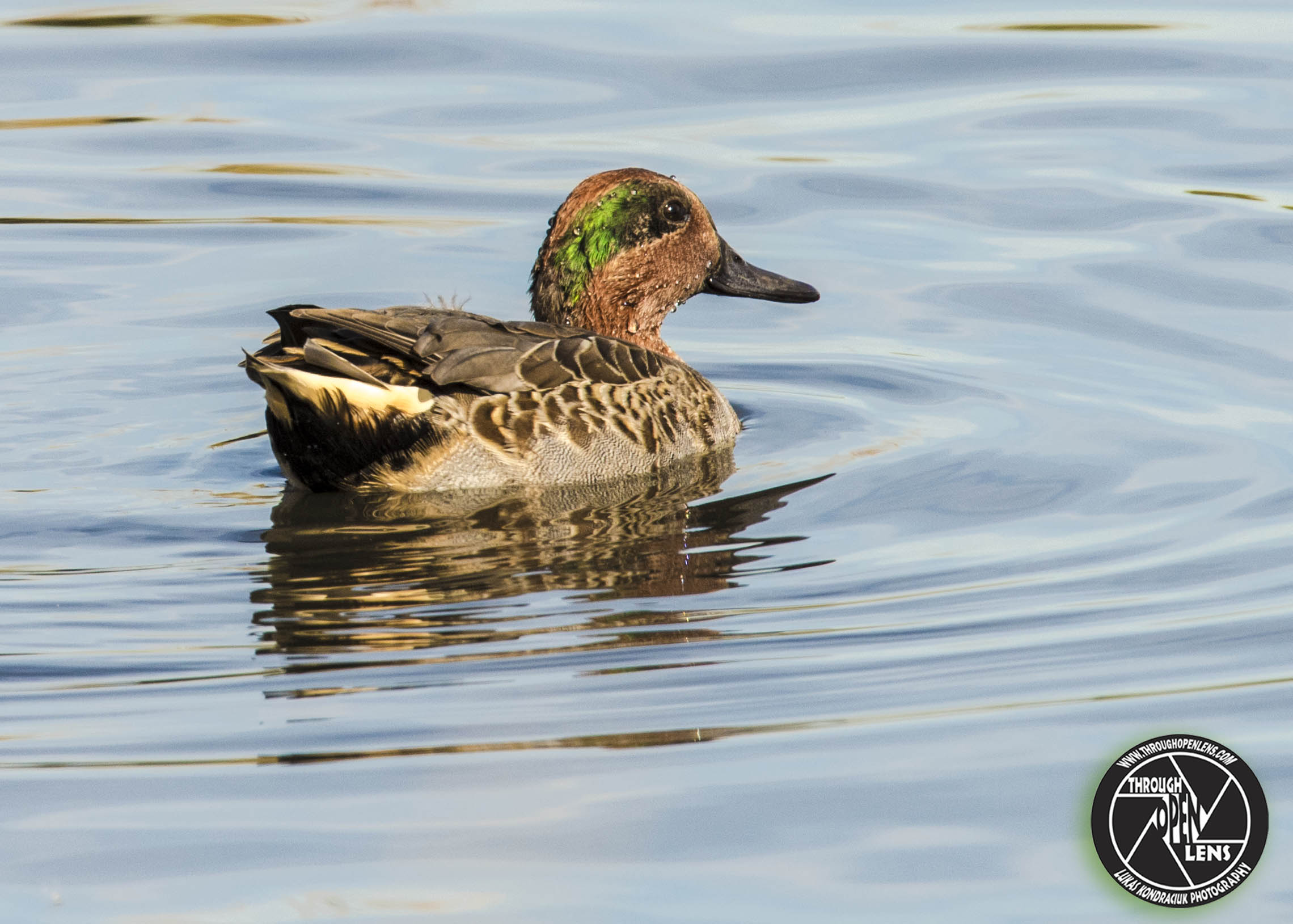
Swim, Duck, Swim!

F/11.0, 1/500, ISO 320.

Green-Winged Teal

Why aren’t there any famous skeletons?

They’re a bunch of no bodies.

Interesting Fact:  The oldest known Green-winged Teal was at least 20 years and 3 months, based on banding data. It was a female banded in 1941 in Oklahoma, and recovered by a hunter 1960 in Missouri. ( https://www.allaboutbirds.org/guide/Green-winged_Teal/lifehistory )

Music Helps Me Escape From The Reality I Live In

F/6.3, 1/320, ISO 400.

Song Sparrow

What did the Mummy movie director say when the final scene was done?

Ok, that’s a wrap.

Interesting Fact:  Some scientists think that Song Sparrows of wet, coastal areas have darker plumage as a defense against feather mites and other decay agents that thrive in humid climates. The darker plumage contains more of a pigment called melanin, which makes feathers tougher and harder to degrade than lighter, unpigmented feathers. ( https://www.allaboutbirds.org/guide/Song_Sparrow/lifehistory )

Dear People, Quit Trying To Look Like Us In Photos… It’s Embarrassing To Our Species.

F/10.0, 1/400, ISO 320.

Gadwall

Why did the can crusher quit his job?

Because it was soda pressing.

Interesting Fact:  Gadwall are dabbling ducks—they ride fairly high in the water and they tip forward to graze on submerged plants that they can reach with their outstretched necks. They rarely dive. Gadwall sometimes steal food from American Coots. ( https://www.allaboutbirds.org/guide/Gadwall/lifehistory )

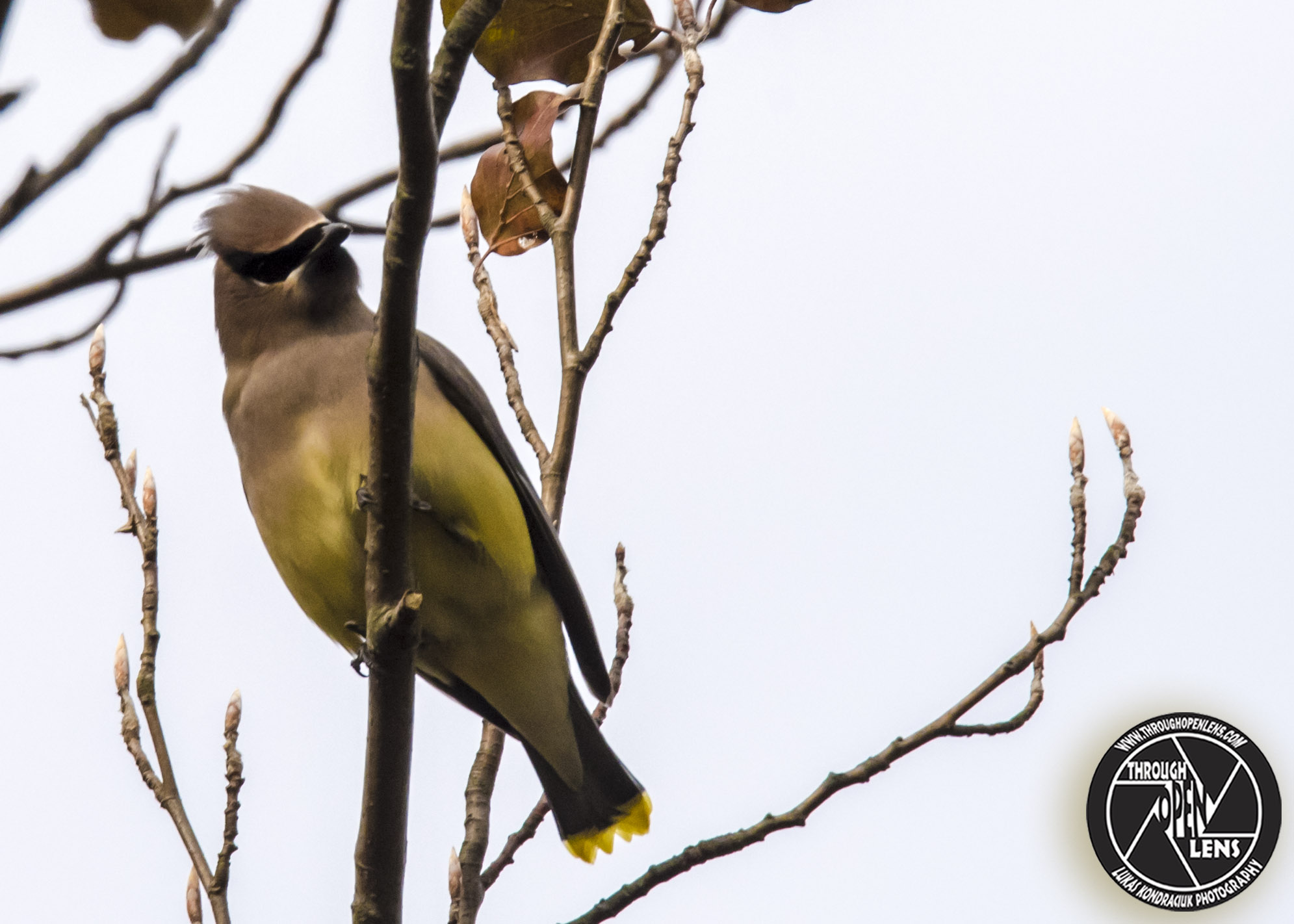
Do I Look Like Cyclops From X-MEN!

F/13.0, 1/640, ISO 400.

Cedar Waxwing

Why was Tigger looking inside the toilet

He was looking for Pooh!

Interesting Fact:  Many birds that eat a lot of fruit separate out the seeds and regurgitate them, but the Cedar Waxwing lets them pass right through. Scientists have used this trait to estimate how fast waxwings can digest fruits. ( https://www.allaboutbirds.org/guide/Cedar_Waxwing/lifehistory )

I Swim Because I Am Too SEXY For A Sport That Requires Clothes

F/6.3, 1/500, ISO 250.

Horned Grebe

Little Red Riding Hood walks all alone through the deep dark wood. Suddenly she hears rustling in a thick bush. Cautiously she moves the branches aside and finds herself facing the big bad wolf.

Little Red Riding Hood: “Oh, Big Bad Wolf, why do you have such huge red eyes?”

Big Bad Wolf: “Go away! I’m crapping!”

Interesting Fact: Dives underwater for food, in open water and among aquatic vegetation. Picks insects off water surface. ( https://www.allaboutbirds.org/guide/Horned_Grebe/lifehistory )

Keep Looking Up That’s The Secret Of Life

F/7.1, 1/200, ISO 320.

Pileated Woodpecker

What did one eyeball say to the other eyeball?

Between you and me something smells.

Interesting Fact: A Pileated Woodpecker pair stays together on its territory all year round. It will defend the territory in all seasons, but will tolerate new arrivals during the winter. ( https://www.allaboutbirds.org/guide/Pileated_Woodpecker/lifehistory )

Yes, I’m On Quack And No, I Don’t Give A Duck!

F/10.0, 1/400, ISO 250.

Bufflehead Duck ( Female )

Why are trees very forgiving?

Because in the Fall they “Let It Go” and in the Spring they “turn over a new leaf”.

Interesting Fact:  Unlike most ducks, the Bufflehead is mostly monogamous, often remaining with the same mate for several years. ( https://www.allaboutbirds.org/guide/Bufflehead/lifehistory )

I Can Freeze Time! What’s Your Superpower?

F/5.6, 1/800, ISO 320.

Anna’s Hummingbird ( Female )

Two pickles fell out of a jar onto the floor.

What did one say to the other?

Dill with it.

Interesting Fact: Hummingbirds have tiny legs and can neither hop nor walk, though they can sort of scoot sideways while perched.  ( https://www.allaboutbirds.org/guide/Annas_Hummingbird )

You Need A Bodyguard To Go Out

F/9.0, 1/320, ISO 250.

Brant Goose

What’s red and bad for your teeth?

A brick.

Interesting Fact: It used to be a strictly coastal bird in winter, seldom leaving tidal estuaries, where it feeds on eel-grass (Zostera marina) and the seaweed, sea lettuce (Ulva). On the east coast of North America, the inclusion of sea lettuce is a recent change to their diet, brought about by a blight on eelgrass in 1931. This resulted in the near-extirpation of the brant. The few that survived changed their diet to include sea lettuce until the eelgrass eventually began to return. Brants have maintained this diet ever since as a survival strategy.[6] In recent decades, it has started using agricultural land a short distance inland, feeding extensively on grass and winter-sown cereals. This may be behavior learned by following other species of geese. Food resource pressure may also be important in forcing this change, as the world population has risen over 10-fold to 400,000-500,000 by the mid-1980s, possibly reaching the carrying capacity of the estuaries. In the breeding season, it uses low-lying wet coastal tundra for both breeding and feeding. The nest is bowl-shaped, lined with grass and down, in an elevated location, often in a small pond. ( https://en.wikipedia.org/wiki/Brant_(goose) )

Emo Ducks

red-breasted-mergansers

F/9.0, 1/320, ISO 200.

Red-breasted Mergansers

Is it dangerous to swim on a full stomach?

Yes. It’s better to swim in water.

Interesting Fact: The Red-breasted Merganser breeds farther north and winters farther south than the other American mergansers. ( https://www.allaboutbirds.org/guide/Red-breasted_Merganser/lifehistory )