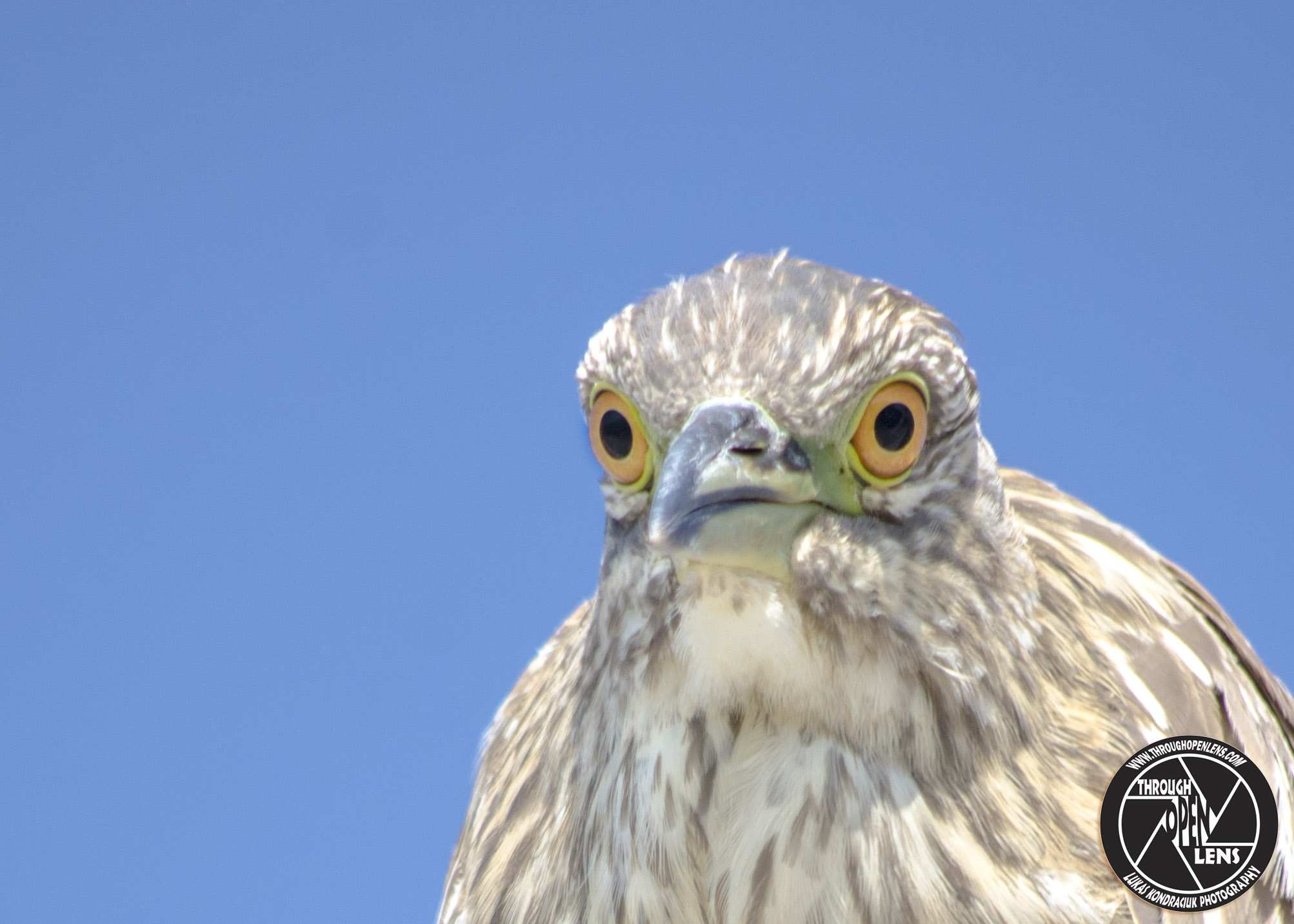
Look Into My Eyes!

F/6.3, 1/640, ISO 200.

Black-crowned Night-Heron

What did a tree fighting with autumn say?

That’s it, I’m leaving.

Interesting Fact: The male chooses a nest site in a tree or in cattails—usually in a habitat safe from predators such as on an island, in a swamp, or over water—and then advertises for a female. Black-crowned Night-Herons nest colonially, often with a dozen nests in a single tree. Colonies sometimes last for 50 years or more. ( https://www.allaboutbirds.org/guide/Black-crowned_Night-Heron/lifehistory )


Kick Your Feet Back Its The Weekend!

F/9.0, 1/320, ISO 200.

Hispaniolan slider

Why do you measure snakes in inches?

Because they don’t have any feet.

Interesting Fact: Whether this creature is found in the wild or in captivity, it has been known to urinate when picked up. This is considered a sign of distress. It also may bite or scratch, but has not been known to cause any severe harm. If found in the wild, the turtle may be more likely to do any one of these. ( https://en.wikipedia.org/wiki/Hispaniolan_slider )


Chillin Like A Villain

F/11.0, 1/500, ISO 320.

Red-winged Blackbird ( Adult Female  )

What does a crying ghost say?

Boo-Hoo

Interesting Fact:  Females build the nests by winding stringy plant material around several close, upright stems and weaving in a platform of coarse, wet vegetation. Around and over this she adds more wet leaves and decayed wood, plastering the inside with mud to make a cup. ( https://www.allaboutbirds.org/guide/Red-winged_Blackbird/lifehistory )

Life Is Good Take It Slow

F/7.1, 1/200, ISO 200.

Hispaniolan slider

What do sheep do on nice summer days?

Go to a baa-baa-cue.

Interesting Fact: Unlike red-eared sliders, they do not have red patches on their heads. They have distinct light and dark stripes on their necks, feet, and tails. The tops of their shells are brown and the bottoms are yellow. ( https://en.wikipedia.org/wiki/Hispaniolan_slider )

If You Dare Come A Little Closer!

F/8.0, 1/1000, ISO 200.

Black-crowned Night-Heron

What did the big chimney say to the little chimney?

“You’re too young to smoke.”

 Interesting Fact: Some populations stay in one place year-round, while others disperse short distances of 5–60 miles. Others migrate farther, such as from Massachusetts to Florida and the Caribbean, or from Alberta to Mexico and Cuba. Migrants follow the coast or the Mississippi River flyway. ( https://www.allaboutbirds.org/guide/Black-crowned_Night-Heron/lifehistory )
You Give Me The Chills!

F/10.0, 1/400, ISO 160.

Red-tailed Hawk

Two snakes are talking.

One of them turns to the other and asks, “Are we venomous?”

The other replays, “Yes,why?…”

“I just bit ma lip.”

Interesting Fact: Red-tailed Hawks typically put their nests in the crowns of tall trees where they have a commanding view of the landscape. They may also nest on a cliff ledge or on artificial structures such as window ledges and billboard platforms. ( https://www.allaboutbirds.org/guide/Red-tailed_Hawk/lifehistory

That Hawkward Moment!

F/7.1, 1/200, ISO 400.

A pirate walks into a bar with a steering wheel on his pants, a peg leg and a parrot on his shoulder. The bartender says, “Hey, you’ve got a steering wheel on your pants.”

The pirate says, “Arrrr, I know. It’s driving me nuts.”

Interesting Fact: ed-tailed Hawks typically put their nests in the crowns of tall trees where they have a commanding view of the landscape. They may also nest on a cliff ledge or on artificial structures such as window ledges and billboard platforms. ( https://www.allaboutbirds.org/guide/Red-tailed_Hawk/lifehistory )

Here’s Looking At You, Kid

F/11.0, 1/500, ISO 320.

Red-tailed Hawk

Why can you never trust atoms?

They make up everything!

Interesting Fact: Birds are amazingly adapted for life in the air. The Red-tailed Hawk is one of the largest birds you’ll see in North America, yet even the biggest females weigh in at only about 3 pounds. A similar-sized small dog might weigh 10 times that. ( https://www.allaboutbirds.org/guide/Red-tailed_Hawk/lifehistory )

If You Can’t Tone It Tan It

F/11.0, 1/500, ISO 250.

Hispaniolan slider

Why did the turtle cross the road?

To get to the shell station!

Interesting Fact:  The Hispaniolan slider is a freshwater turtle. They can live on land and water, but prefer to be near freshwater.[3] These sliders are not on the endangered list, but are considered vulnerable. ( https://en.wikipedia.org/wiki/Hispaniolan_slider )

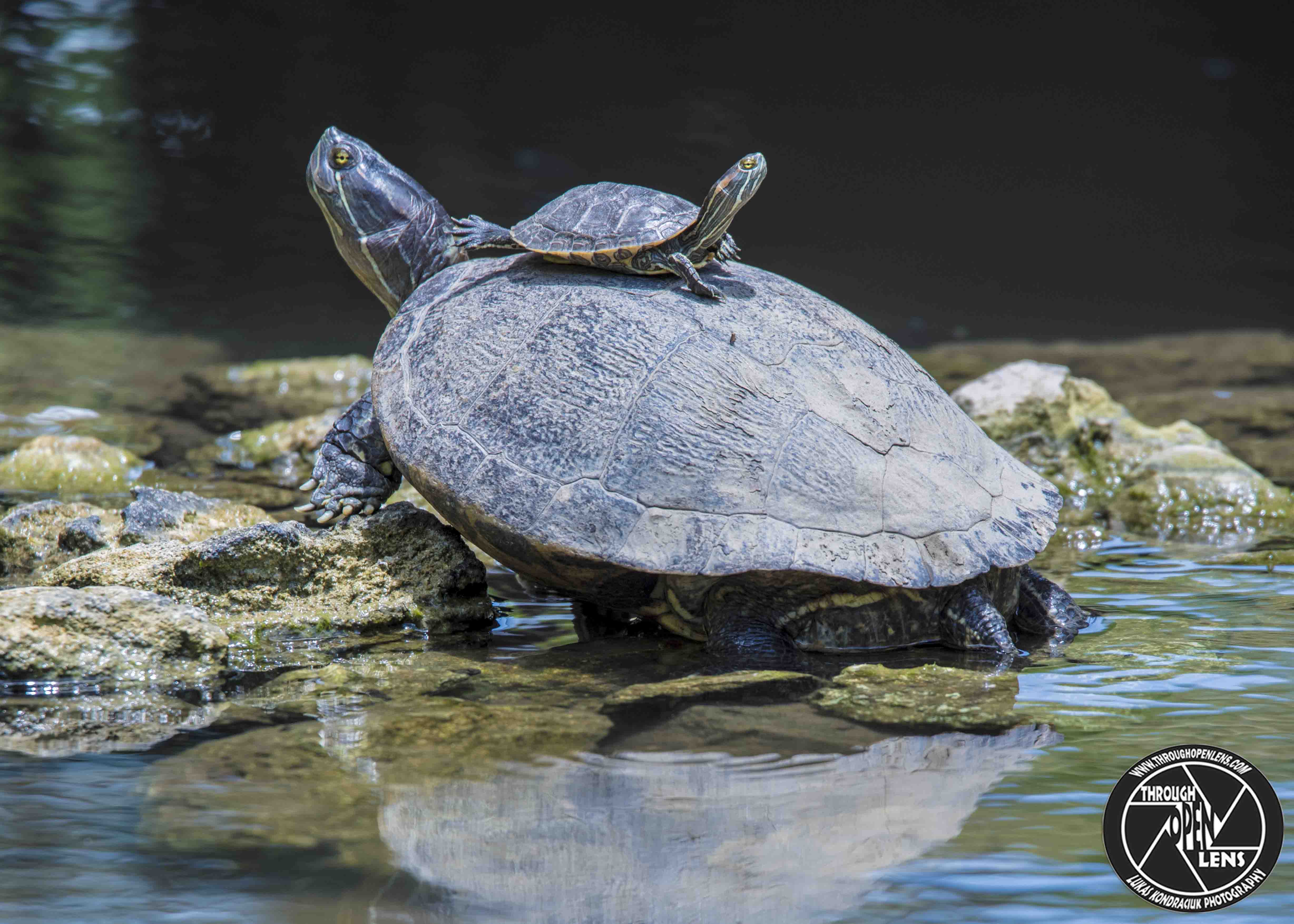
Only The Bold Get To The Top.

F/8.0, 1/250, ISO 320.

Red-Eared Slider Turtles

Why did the nurse go to art school?

To learn how to draw blood!

Interesting Fact: Red-eared sliders are almost entirely aquatic, but as they are cold-blooded, they leave the water to sunbathe to regulate their temperature. ( https://en.wikipedia.org/wiki/Red-eared_slider )