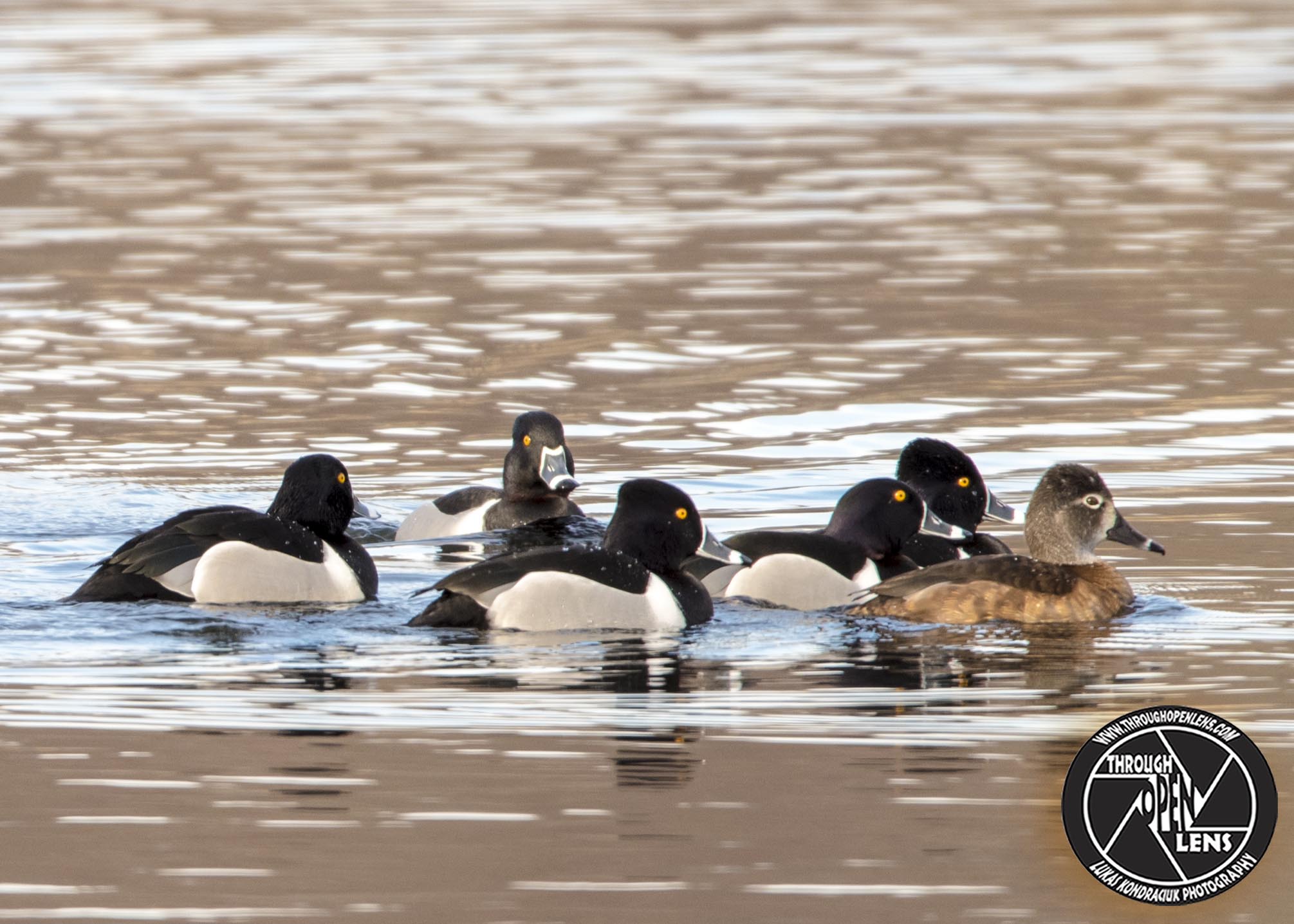
It’s The New Year, Get Your Ducks In A Row!

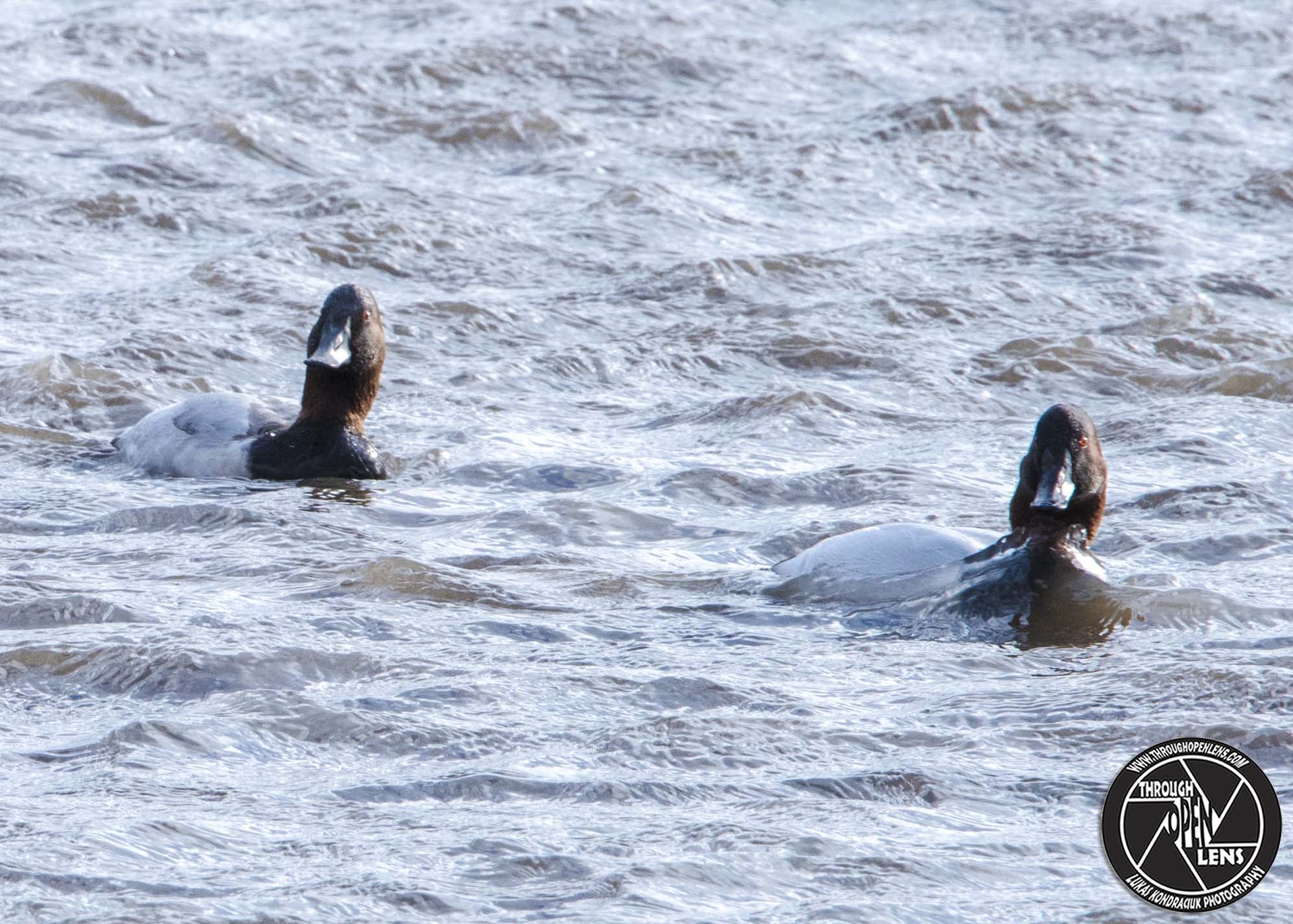
F/9.0, 1/320, ISO 320.

Ring-necked Ducks

What time is it when an elephant sits on your fence?

Time to get a new fence!

Interesting Fact: They tend to remain in pairs during the breeding season but group into flocks of several to several thousand during migration and winter. Like many other ducks, the Ring-necked Duck uses many kinds of displays to ward off rivals and to seek mates; almost any group of ducks offers an opportunity to watch these displays at work. When warning away another bird, Ring-necked Ducks lower their bill to meet their chest or push against each other, breast to breast, while swimming. This can intensify to bites and blows with the wings, particularly during the breeding season. When courting, males often throw their head sharply backward, touching the back; swim rapidly while nodding the head; or act as if they are preening their wing. As pairs begin to form, the two birds may perform exaggerated neck stretches or dip their bills in the water as if drinking. Pairs tend to form in spring and stay together at least until incubation begins. ( https://www.allaboutbirds.org/guide/Ring-necked_Duck/lifehistory )

I’m A Biter!

F/10.0, 1/400, ISO 800.

Common Loon ( Nonbreeding adult )

Why did the teddy bear say no to dessert?

Because she was stuffed.

Interesting Fact: Loons shoot through the water like a torpedo, propelled by powerful thrusts of feet located near the rear of their body. When their quarry changes direction, loons can execute an abrupt flip-turn that would make Olympic swimmers jealous: they extend one foot laterally as a pivot brake and kick with the opposite foot to turn 180 degrees in a fraction of a second. ( https://www.allaboutbirds.org/guide/Common_Loon/lifehistory )


Look Into My Eyes And Jump Into My Mouth… Fish!

F/9.0, 1/320, ISO 160.

Green Heron

Where do bees go to the bathroom?

At the BP station!

Interesting Fact: Both the male and female brood and feed the chicks, which may stay with their parents for more than a month after leaving the nest, as they learn to forage. Green Herons protect their feeding areas by driving away other species, such as American Coots, that approach too closely. ( https://www.allaboutbirds.org/guide/Green_Heron/lifehistory )

Baby It’s Cold Outside!

F/8.0,1/250, ISO 400.

Northern Cardinal Male 

Why did Scrooge keep a pet lamb?

Because it would say, “Baaaaahh humbug!”

Interesting Fact: Look for Northern Cardinals in dense shrubby areas such as forest edges, overgrown fields, hedgerows, backyards, marshy thickets, mesquite, regrowing forest, and ornamental landscaping. Cardinals nest in dense foliage and look for conspicuous, fairly high perches for singing. Growth of towns and suburbs across eastern North America has helped the cardinal expand its range northward. ( https://www.allaboutbirds.org/guide/Northern_Cardinal/lifehistory )


Ride On Santa!

F/8.0, 1/250, ISO 100.

Merry Christmas And Happy Holidays To All

Santa Claus Horseback Riding

What did the Christmas tree say to the ornament?

Quit hanging around!

Interesting Fact: In the Early Middle Ages, Christmas Day was overshadowed by Epiphany, which in western Christianity focused on the visit of the magi. But the medieval calendar was dominated by Christmas-related holidays. The forty days before Christmas became the “forty days of St. Martin” (which began on November 11, the feast of St. Martin of Tours), now known as Advent.[83] In Italy, former Saturnalian traditions were attached to Advent.[83] Around the 12th century, these traditions transferred again to the Twelve Days of Christmas (December 25 – January 5); a time that appears in the liturgical calendars as Christmastide or Twelve Holy Days. ( https://en.wikipedia.org/wiki/Christmas#History )


What Would You Like For Christmas?

F/5.6, 1/100, ISO 320.

Happy Christmas Eve Everyone

Santa Claus

What do you call a kid who doesn’t believe in Santa?

A rebel without a Claus!

Interesting Fact: Santa Claus is generally depicted as a portly, jolly, white-bearded man—sometimes with spectacles—wearing a red coat with white fur collar and cuffs, white-fur-cuffed red trousers, red hat with white fur, and black leather belt and boots and carrying a bag full of gifts for children. This image became popular in the United States and Canada in the 19th century due to the significant influence of the 1823 poem “A Visit from St. Nicholas” and of caricaturist and political cartoonist Thomas Nast.[2][3][4] This image has been maintained and reinforced through song, radio, television, children’s books, films, and advertising.  ( https://en.wikipedia.org/wiki/Santa_Claus )


A song told me to Deck the Halls…so I did! Mr.and Mrs. Hall are not very happy!

F/11.0, 1/500, ISO 500.

Canvasback 

Did you hear the joke about the roof?

Never mind, it’s over your head!

Interesting Fact: Canvasbacks are diving ducks at home in the water, seldom going ashore to dry land. They sleep on the water with their bill tucked under the wing, and they nest on floating mats of vegetation. To get airborne Canvasbacks need a running start, but once in the air they are strong and fast fliers, clocking airspeeds of up to 56 miles per hour. ( https://www.allaboutbirds.org/guide/Canvasback/lifehistory )

I Will Flash You From Far Away!

F/8.0, 1/250, ISO 400.

Goat Island Lighthouse ( Rhode Island )

What four letters will frighten a burglar?

O I C U

Interesting Fact: On Friday, 19 July 1723, twenty-six pirates were buried on the north end of Goat Island, on the shore, between high and low water mark. The significance of this placement is that, to Christians of this era, this inter-tidal land was considered “unhallowed ground,” like burials placed outside of a consecrated cemetery. The men had been tried in Newport between 10 and 12 July and hanged at nearby Bull’s Point (Gravelly Point). They were: Charles Harris, Thomas Linicar, Daniel Hyde, Stephen Mundon, Abraham Lacy, Edward Lawson, John Tomkins, Francis Laughton, John Fisgerald, William Studfield, Owen Rice, William Read, John Bright, Thomas Hazel, William Blades (Rhode Island), Thomas Hagget, Peter Cues, William Jones, Edward Eaton, John Brown, James Sprinkly, Joseph Sound, Charles Church, John Waters, Thomas Powell (Connecticut), and Joseph Libbey.[2] “The pirates were all young men, most of them natives of England.”[3] The following is taken from The Salem Observer, November 11, 1843: “…this was the most extensive execution of pirates that ever took place at one time in the Colonies, it was attended by a vast multitude from every part of New England.” ( https://en.wikipedia.org/wiki/Goat_Island_(Rhode_Island) )

What Drives You Nuts?!

F/6.3, 1/100, ISO 320.

American Red Squirrel

Why do squirrels swim on there back?

To keep their nuts dry!

Interesting Fact: Red squirrels can be easily distinguished from other North American tree squirrels by their smaller size, 28–35 cm (11–14 in) total length (including tail), territorial behavior, and reddish fur with a white venter (underbelly).[6] Red squirrels are somewhat larger than chipmunks. The Douglas squirrel is morphologically similar to the American red squirrels, but has a rust-colored venter and is restricted to the southwestern coast of British Columbia and in the Pacific Northwest of the United States. These species’ ranges do not overlap.  ( https://en.wikipedia.org/wiki/American_red_squirrel )

Let It Snow! Let It Snow! The Cold Never Bothered Me Anyway!

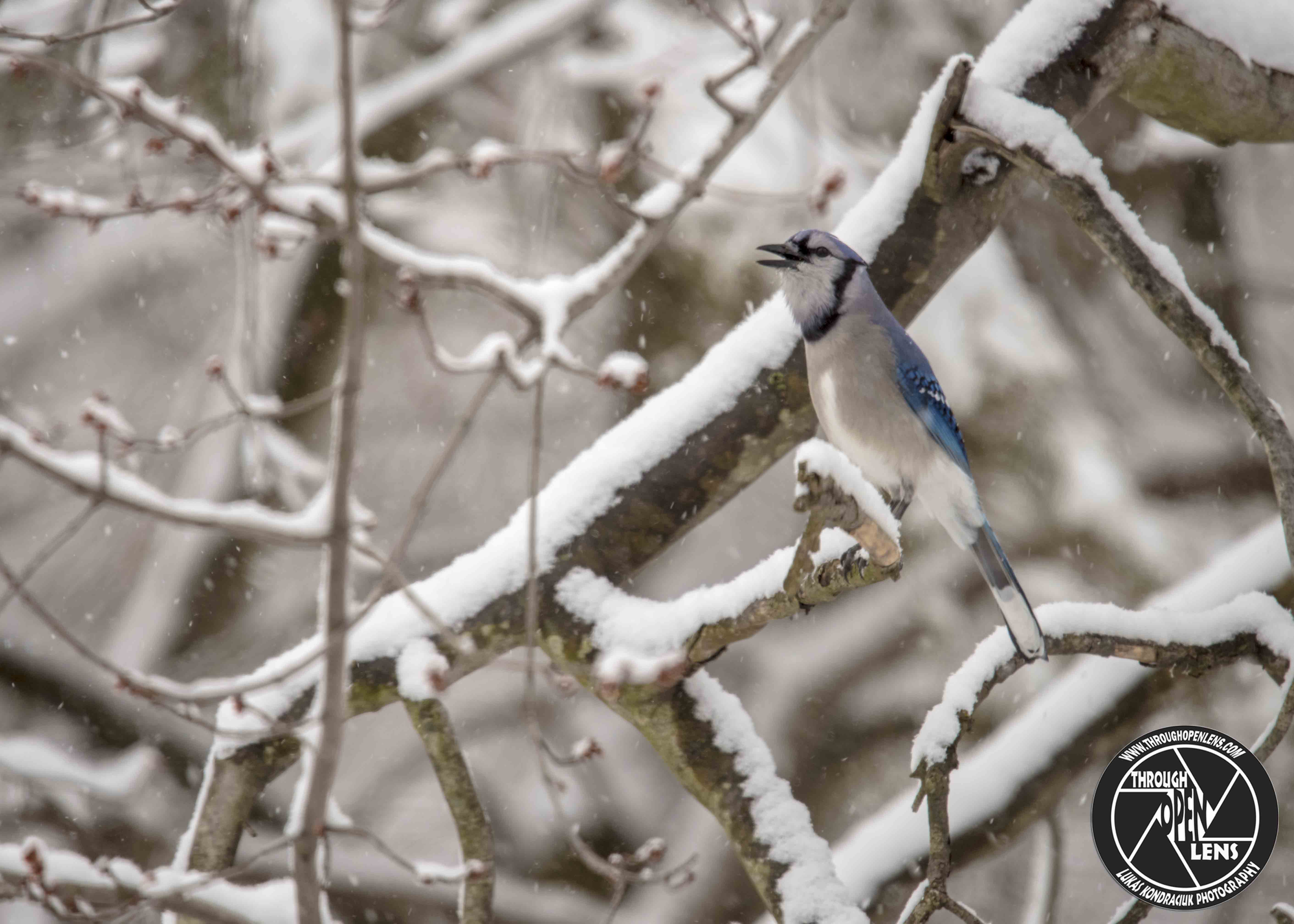
F/6.3, 1/160, ISO 400.

Blue Jay

Bobby went in to a pet shop.

He asked the employee, “Can I buy a goldfish?”

The employee: “Do you want an aquarium?”

Bobby: “I don’t care what star sign it is.”

Interesting Fact: Blue Jays are known to take and eat eggs and nestlings of other birds, but we don’t know how common this is. In an extensive study of Blue Jay feeding habits, only 1% of jays had evidence of eggs or birds in their stomachs. Most of their diet was composed of insects and nuts. (  https://www.allaboutbirds.org/guide/Blue_Jay )