
F/9.0, 1/320, ISO 250.
Carolina Wren
How do you drown a Hipster?
In the mainstream.
Interesting Fact: They are known to build multiple nests to confuse predators. ( http://identify.whatbird.com/obj/677/overview/Carolina_Wren.aspx )

F/9.0, 1/320, ISO 250.
Carolina Wren
How do you drown a Hipster?
In the mainstream.
Interesting Fact: They are known to build multiple nests to confuse predators. ( http://identify.whatbird.com/obj/677/overview/Carolina_Wren.aspx )
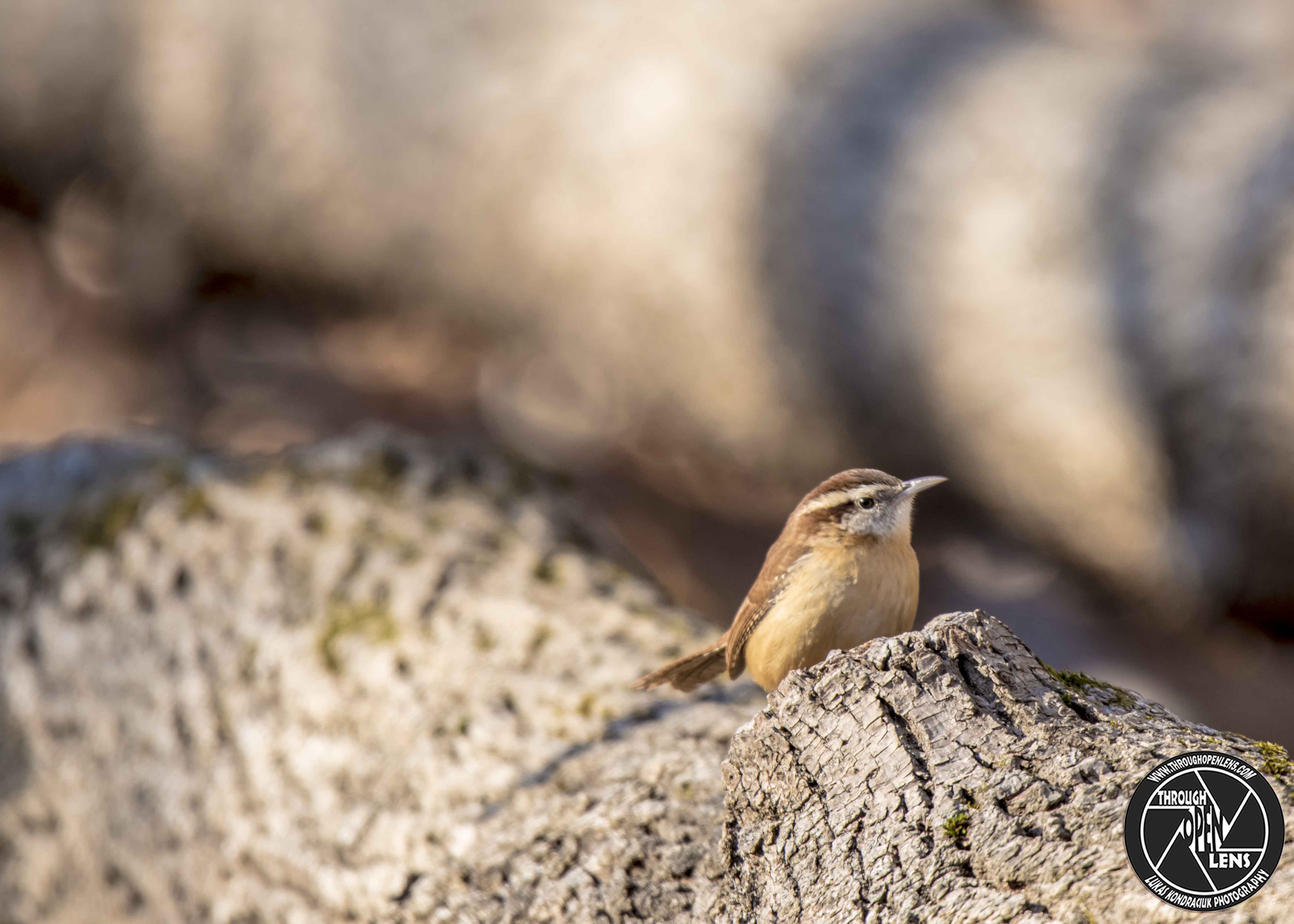
F/8.0, 1/125, ISO 400.
Carolina Wren
What did one autumn leaf say to the other?
I’m falling for you.
Interesting Fact: They climb up vines, trunks, and branches, poking into squirrel nests and probing nooks and crannies in search of insects. Carolina Wrens use their curved bills to turn over decaying vegetation and to hammer and shake apart large bugs. They roost in bird boxes, abandoned hornet nests, hanging plants, garages, barns, old nests, and other shelters. A weak flyer, this wren makes brief, quick aerial forays over short distances. Pairs stay bonded year-round, with no vacation from singing or defending territory. ( https://www.allaboutbirds.org/guide/Carolina_Wren/lifehistory )
 F/10.0, 1/400, ISO 320.
Mallard
What do you call a duck that steals?
A robber ducky.
Interesting Fact: Mallards nest on the ground on dry land that is close to water; nests are generally concealed under overhanging grass or other vegetation. Occasionally, Mallards nest in agricultural fields, especially alfalfa but also winter wheat, barley, flax, and oats. Both urban and wild populations readily nest in artificial nesting structures. Pairs search for nest sites together, typically on evening flights circling low over the habitat. Occasionally nests are placed on floating mats of vegetation or woven into plant stems that rise out of the water. ( https://www.allaboutbirds.org/guide/Mallard/lifehistory )
 F/10.0, 1/400, ISO 160.
Black-capped Chickadee
What do you call a gorilla wearing ear-muffs?
Anything you like! He can’t hear you!
Interesting Fact: There is a dominance hierarchy within flocks. Some birds are “winter floaters” that don’t belong to a single flock—these individuals may have a different rank within each flock they spend time in. ( https://www.allaboutbirds.org/guide/Black-capped_Chickadee/lifehistory )

F/8.0, 1/250, ISO 320.
Downy Woodpecker
What’s the problem with twin witches?
You never know which witch is which.
Interesting Fact: Downy Woodpeckers nest in dead trees or in dead parts of live trees. They typically choose a small stub (averaging around 7 inches in diameter) that leans away from the vertical, and place the entrance hole on the underside. Nest trees are often deciduous and the wood is often infected with a fungus that softens the wood, making excavating easier. ( https://www.allaboutbirds.org/guide/Downy_Woodpecker/lifehistory )

F/8.0, 1/125, ISO 125.
White-breasted Nuthatch
What do bulls do when they go shopping?
They CHARGE!
Interesting Fact: White-breasted Nuthatches typically build their nests in natural tree cavities or abandoned woodpecker holes. They sometimes enlarge these holes but rarely excavate them entirely on their own (as Red-breasted Nuthatches often do). Nuthatches are smaller than woodpeckers, and White-breasted Nuthatches don’t seem bothered by nest holes considerably larger than they are. Despite their association with deciduous woods, they nest in both coniferous and deciduous trees. White-breasted Nuthatches sometimes use nest boxes. ( https://www.allaboutbirds.org/guide/White-breasted_Nuthatch/lifehistory )

F/7.1, 1/200, ISO 320.
Pileated Woodpecker
What did one eyeball say to the other eyeball?
Between you and me something smells.
Interesting Fact: A Pileated Woodpecker pair stays together on its territory all year round. It will defend the territory in all seasons, but will tolerate new arrivals during the winter. ( https://www.allaboutbirds.org/guide/Pileated_Woodpecker/lifehistory )

F/6.3, 1/100, ISO 500.
Wild Turkeys ( Male )
A blonde driving a car became lost in a snowstorm.
She didn’t panic however, because she remembered what her dad had once told her. “If you ever get stuck in a snowstorm, just wait for a snow plow to come by and follow it.”
Sure enough, pretty soon a snow plow came by, and she started to follow it.
She followed the plow for about forty-five minutes. Finally the driver of the truck got out and asked her what she was doing.
And she explained that her dad had told her if she ever got stuck in a snow storm, to follow a plow.
The driver nodded and said, “Well, I’m done with the Wal-Mart parking lot, do you want to follow me over to Best Buy now?”
Interesting Fact: Wild Turkeys nest on the ground in dead leaves at the bases of trees, under brush piles or thick shrubbery, or occasionally in open hayfields. ( https://www.allaboutbirds.org/guide/Wild_Turkey/lifehistory )
Happy St Patrick’s Day!

F/8.0, 1/125, ISO 110.
Monk Parakeets
Why don’t you iron 4-Leaf clovers?
Because you don’t want to press your luck.
Interesting Fact: Monk Parakeets kept in captivity can learn to mimic human speech. ( https://www.t.org/guide/Monk_Parakeet/lifehistory )
Interesting Fact: Saint Patrick’s Day, or the Feast of Saint Patrick(Irish: Lá Fhéile Pádraig, “the Day of the Festival of Patrick”), is a cultural and religious celebration held on 17 March, the traditional death date of Saint Patrick (c. AD 385–461), the foremost patron saint of Ireland. ( https://en.wikipedia.org/wiki/Saint_Patrick%27s_Day )

F/8.0, 1/1000, ISO 400.
Red-Bellied Woodpecker
Teacher: “Bobby what do you want to be when you grow up?”
Bobby: “A doctor.”
Teacher: “And why’s that?”
Bobby: “Because it’s the only profession where you can tell women to take off their clothes and then stick their husbands with the bill.”
Interesting Fact: These birds often stick to main branches and trunks of trees, where they hitch in classic woodpecker fashion, leaning away from the trunk and onto their stiff tail feathers as they search for food hiding in bark crevices. ( https://www.allaboutbirds.org/guide/Red-bellied_Woodpecker/lifehistory )
 Through Open Lens