I Am Too Busy Working On My Own Grass To Notice If Yours Is Greener

F/6.3, 1/250, ISO 640.

Muskrat

Why is sex like math?

You add a bed, subtract the clothes, divide the legs, and pray there’s no multiplying!

Interesting Fact: Muskrats provide an important food resource for many other animals, including minkfoxescoyoteswolveslynxbobcatsbearseaglessnakesalligators, and large owls and hawksOtterssnapping turtles, and large fish such as pike prey on baby muskrats. Caribou and elk sometimes feed on the vegetation which makes up muskrat push-ups during the winter when other food is scarce for them.[24] In their introduced range in the former Soviet Union, the muskrat’s greatest predator is the golden jackal. They can be completely eradicated in shallow water bodies, and during the winter of 1948–49 in the Amu Darya (river in central Asia), muskrats constituted 12.3% of jackal faeces contents, and 71% of muskrat houses were destroyed by jackals, 16% of which froze and became unsuitable for muskrat occupation. Jackals also harm the muskrat industry by eating muskrats caught in traps or taking skins left out to dry. ( https://en.wikipedia.org/wiki/Muskrat#Behavior )

Only The Bold Get To The Top.

F/8.0, 1/250, ISO 320.

Red-Eared Slider Turtles

Why did the nurse go to art school?

To learn how to draw blood!

Interesting Fact: Red-eared sliders are almost entirely aquatic, but as they are cold-blooded, they leave the water to sunbathe to regulate their temperature. ( https://en.wikipedia.org/wiki/Red-eared_slider )


Don’t Be Afraid To Rock The Boat

F/13.0, 1/640, ISO 200.

Jersey City Hudson River

What does a cheetah say when someone looks at it?

I’ve been spotted!

Interesting Fact: The land comprising what is now Jersey City was inhabited by the Lenape, a collection of tribes (later called Delaware Indian). In 1609, Henry Hudson, seeking an alternate route to East Asia, anchored his small vessel Halve Maen (English: Half Moon) at Sandy Hook, Harsimus Cove and Weehawken Cove, and elsewhere along what was later named the North River. After spending nine days surveying the area and meeting its inhabitants, he sailed as far north as Albany. By 1621, the Dutch West India Company was organized to manage this new territory and in June 1623, New Netherland became a Dutch province, with headquarters in New Amsterdam. Michael Reyniersz Pauw received a land grant as patroon on the condition that he would establish a settlement of not fewer than fifty persons within four years. He chose the west bank of the North River (Hudson River) and purchased the land from the Lenape. This grant is dated November 22, 1630 and is the earliest known conveyance for what are now Hoboken and Jersey City. Pauw, however, was an absentee landlord who neglected to populate the area and was obliged to sell his holdings back to the Company in 1633.[39] That year, a house was built at Communipaw for Jan Evertsen Bout, superintendent of the colony, which had been named Pavonia (the Latinized form of Pauw’s name, which means peacock).[40] Shortly after, another house was built at Harsimus Cove and became the home of Cornelius Van Vorst, who had succeeded Bout as superintendent, and whose family would become influential in the development of the city. Relations with the Lenape deteriorated, in part because of the colonialist’s mismanagement and misunderstanding of the indigenous people, and led to series of raids and reprisals and the virtual destruction of the settlement on the west bank. During Kieft’s War, approximately eighty Lenapes were killed by the Dutch in a massacre at Pavonia on the night of February 25, 1643. ( https://en.wikipedia.org/wiki/Jersey_City,_New_Jersey#History )

POLLEN: When Flowers Can’t Keep It In Their Plants.

F/14.0, 1/60, ISO 250.

Daylily

Why did the gardener plant a light bulb?

She wanted to grow a power plant!

Interesting Fact: Daylilies are perennial plants, whose name alludes to the flowers which typically last no more than 24 hours (about a day or so). The flowers of most species open in early morning and wither during the following night, possibly replaced by another one on the same scape (flower stalk) the next day. Some species are night-blooming. Daylilies are not commonly used as cut flowers for formal flower arranging, yet they make good cut flowers otherwise as new flowers continue to open on cut stems over several days. ( https://en.wikipedia.org/wiki/Daylily#Etymology )

That’s Not A Wild Goose Chase. That’s Bingo.

F/7.1, 1/200, ISO 400.

Domestic Geese in Wild

Which two letters in the alphabet are always jealous?

NV.

Interesting Fact: In Europe, northern Africa, and western Asia, the original domesticated geese are derived from the greylag goose Anser anser. In eastern Asia, the original domesticated geese are derived from the swan goose Anser cygnoides; these are commonly known as Chinese geese. Both have been widely introduced in more recent times, and modern flocks in both areas (and elsewhere, such as Australia and North America) may consist of either species, and/or hybrids between them. Chinese geese may be readily distinguished from European geese by the large knob at the base of the bill, though hybrids may exhibit every degree of variation between them. ( https://en.m.wikipedia.org/wiki/Domestic_goose )

Next Time I Am Wearing Green!

F/6.3, 1/ 160, ISO 320.

Chipping Sparrow

How do farmers party?

They turnip the beets.

Interesting Fact: The early naturalists had a gift for description you just don’t see anymore. In 1929, Edward Forbush called the Chipping Sparrow “the little brown-capped pensioner of the dooryard and lawn, that comes about farmhouse doors to glean crumbs shaken from the tablecloth by thrifty housewives.” ( https://www.allaboutbirds.org/guide/Chipping_Sparrow/lifehistory )

Relax, We’re All Crazy It’s Not A Competition!

F/10.0, 1/400, ISO 250.

Song Sparrow

Where do polar bears vote?

The North Poll.

Interesting Fact: The Song Sparrow is found throughout most of North America, but the birds of different areas can look surprisingly different. Song Sparrows of the Desert Southwest are pale, while those in the Pacific Northwest are dark and heavily streaked. Song Sparrows of Alaska’s Aleutian Islands chain are even darker, and they’re huge: one-third longer than the eastern birds, and weighing twice as much.  ( https://www.allaboutbirds.org/guide/Song_Sparrow/lifehistory )


We Are Not Short, We Are Just More Down To Earth Than Other Birds.

F/5.6, 1/500, ISO 320.

Least Sandpiper

A termite walks into a bar and says, “Where is the bar tender?”

Interesting Fact: The Least Sandpiper is the smallest shorebird in the world, weighing in at about 1 ounce and measuring 5-6 inches long. Males are slightly smaller than females. ( https://www.allaboutbirds.org/guide/Least_Sandpiper/lifehistory )

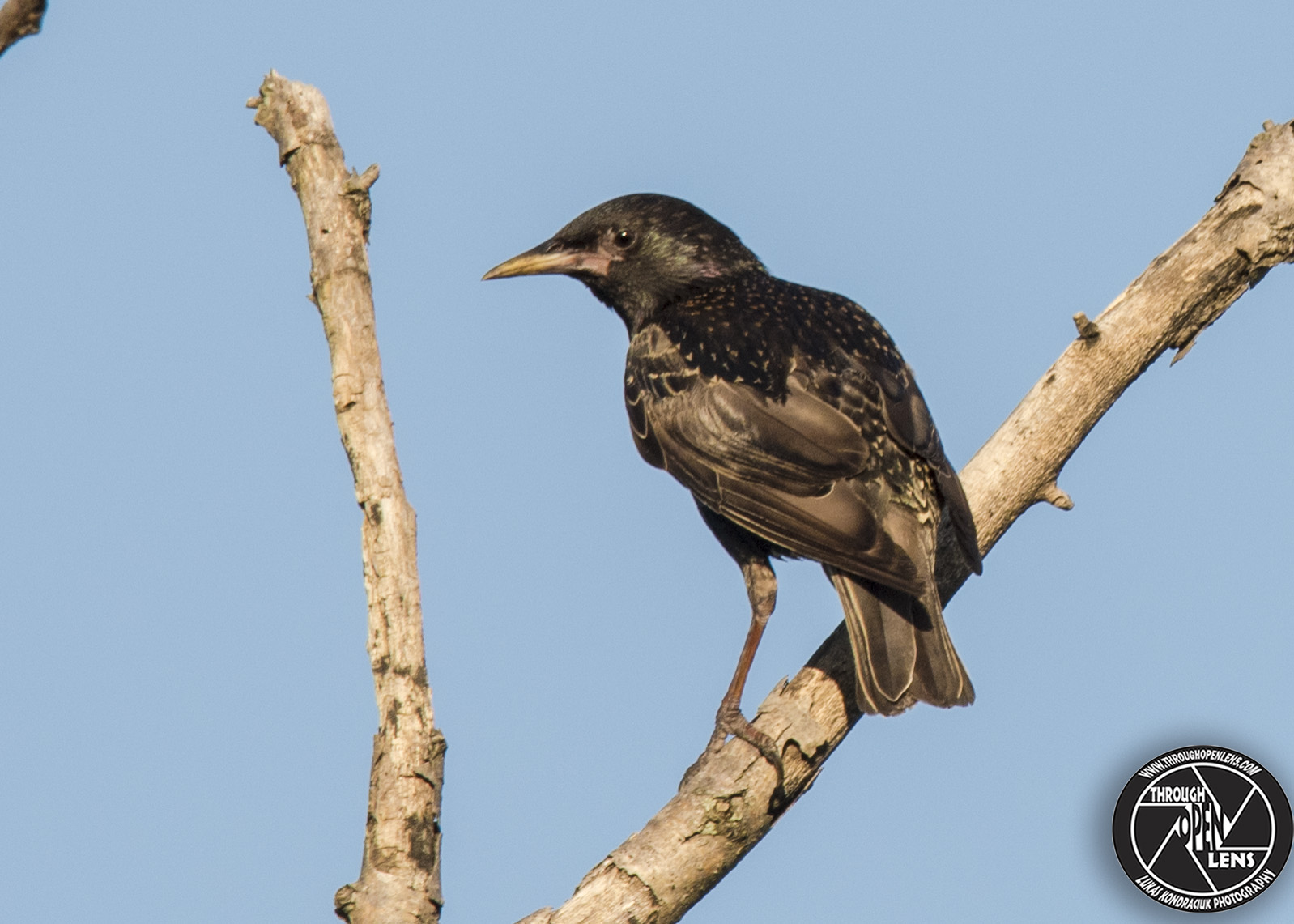
A Simple Hello Could Lead To Million Things

F/11.0, 1/500, ISO 250.

European Starling

What’s the difference between a guitar and a fish?

You can’t tuna fish.

Interesting Fact: Starlings turn from spotted and white to glossy and dark each year without shedding their feathers. The new feathers they grow in fall have bold white tips – that’s what gives them their spots. By spring, these tips have worn away, and the rest of the feather is dark and iridescent brown. It’s an unusual changing act that scientists term “wear molt.” ( https://www.allaboutbirds.org/guide/European_Starling/lifehistory )

The Call Of The Wild

F/13.0, 1/640, ISO 200.

Eastern Phoebe

What happens if you eat yeast and shoe polish?

Every morning you’ll rise and shine!

Interesting Fact: In 1804, the Eastern Phoebe became the first banded bird in North America. John James Audubon attached silvered thread to an Eastern Phoebe’s leg to track its return in successive years. ( https://www.allaboutbirds.org/guide/Eastern_Phoebe/lifehistory )