Just Out And About!

F/7.1, 1/200, ISO 400.

Pied-Billed Grebe

How is being at a singles bar different from going to the circus?

At the circus the clowns don’t talk.

Interesting Fact: When in danger, Pied-billed Grebes sometimes make a dramatic “crash-dive” to get away. A crash-diving grebe pushes its body down with its wings thrust outward. Its tail and head disappears last, while the bird kicks water several feet into the air. ( https://www.allaboutbirds.org/guide/Pied-billed_Grebe/ )

Let’s Get Soaking Wet!

F/5.6, 1/500, ISO320.

American Robin

What did the bartender say after a book walked into the bar?

“Please, no stories!”

Interesting Fact: Robins eat a lot of fruit in fall and winter. When they eat honeysuckle berries exclusively, they sometimes become intoxicated. ( https://www.allaboutbirds.org/guide/American_Robin )

Never Bend Your Head. Always Hold It High. Look The World Straight In The Eye.

F/10.0, 1/400, ISO 320.

Curve-billed Thrasher

A wife says, “Hey! Look at that funny guy whose been drinking a lot.”

The husband responds, “Who is he?”

The wife answers, “Well, five years ago, he was my boyfriend and I denied him for marriage.”

The husband says, “Oh my God! He’s still celebrating his freedom!”

Interesting Fact: The Curve-billed Thrasher that lives in the Sonoran Desert of Arizona and northwestern Mexico looks different than the form that lives in the Chihuahuan Desert of Texas and central Mexico, and they may be separate species. The Texas and eastern bird has a lighter breast, more contrasting spots, pale wingbars, and white tail corners. The more western form has a grayer breast with less obvious spots, inconspicuous wingbars, and smaller, more grayish tail corners. ( https://www.allaboutbirds.org/guide/Curve-billed_Thrasher/lifehistory )

TAIL Me What You Think?

F/8.0, 1/250, ISO 200.

Great-tailed Grackle

Why did Frosty the snowman want a divorce?

Because he thought his wife was a flake

Interesting Fact: In winter, enormous flocks of both male and female Great-tailed Grackles gather in “roost trees.” These winter roosts can contain thousands of individuals, with flocks of up to half a million occurring in sugarcane fields in Texas’s Rio Grande Valley. (  https://www.allaboutbirds.org/guide/Great-tailed_Grackle/overview  )

I Think I’m In Love. No Wait, I Was Just Hungry.

F/11.0,1/500, ISO 800.

Bananaquit

What do you call a laughing motorcycle?

“Yamahahaha”

Interesting Fact: The bananaquit has a slender, curved bill, adapted to taking nectar from flowers. It sometimes pierces flowers from the side, taking the nectar without pollinating the plant.[18] It also feeds on sweet juices by puncturing fruit with its beak, and will eat small insects on occasion. While feeding, the bananaquit must always perch as it cannot hover like a hummingbird. ( https://en.wikipedia.org/wiki/Bananaquit )

Caution Chicks At Play! 

F/5.6, 1/1000, ISO 200.

Wild Turkeys Chicks

What did the mama turkey say to her naughty son?

If your papa could see you now, he’d turn over in his gravy!

Interesting Fact: Male Wild Turkeys provide no parental care. Newly hatched chicks follow the female, who feeds them for a few days until they learn to find food on their own. As the chicks grow, they band into groups composed of several hens and their broods. Winter groups sometimes exceed 200 turkeys. ( https://www.allaboutbirds.org/guide/Wild_Turkey/lifehistory )

I Have Chills All Over My Body.

F/10.0, 1/400, ISO 320.

Red-winged Blackbird

Which runs faster, hot or cold?

Hot. Everyone can catch cold.

One California subspecies of the Red-winged Blackbird lacks the yellow borders to the red shoulders (epaulets) and has been dubbed the “bicolored blackbird.” Some scientists think this plumage difference may help Red-winged Blackbirds recognize each other where their range overlaps with the similar Tricolored Blackbird. ( https://www.allaboutbirds.org/guide/Red-winged_Blackbird/lifehistory )


Lifeguards Are On Duty, Try Not To Die!

F/8.0, 1/250, ISO 200.

Turkey Vultures

What did the hot dog say after the race?

I’m a winer!

Interesting Fact: Turkey Vultures eat carrion, which they find largely by their excellent sense of smell. Mostly they eat mammals but are not above snacking on reptiles, other birds, amphibians, fish, and even invertebrates. They prefer freshly dead animals, but often have to wait for their meal to soften in order to pierce the skin. They are deft foragers, targeting the softest bits first and are even known to leave aside the scent glands of dead skunks. ( https://www.allaboutbirds.org/guide/Turkey_Vulture/lifehistory )

What The Hell Am I Looking At?!

F/6.3, 1/160, IOS 320.

Wild Turkey

Why do turkeys eat so little?

Because they are always stuffed!

Interesting Fact:They usually roost in flocks, but sometimes individually. Courting males gobble to attract females and warn competing males. They display for females by strutting with their tails fanned, wings lowered, while making nonvocal hums and chump sounds. Males breed with multiple mates and form all-male flocks outside of the breeding season, leaving the chick-rearing to the females, The chicks travel in a family group with their mother, often combining with other family groups to form large flocks of young turkeys accompanied by two or more adult females. ( https://www.allaboutbirds.org/guide/Wild_Turkey/lifehistory )

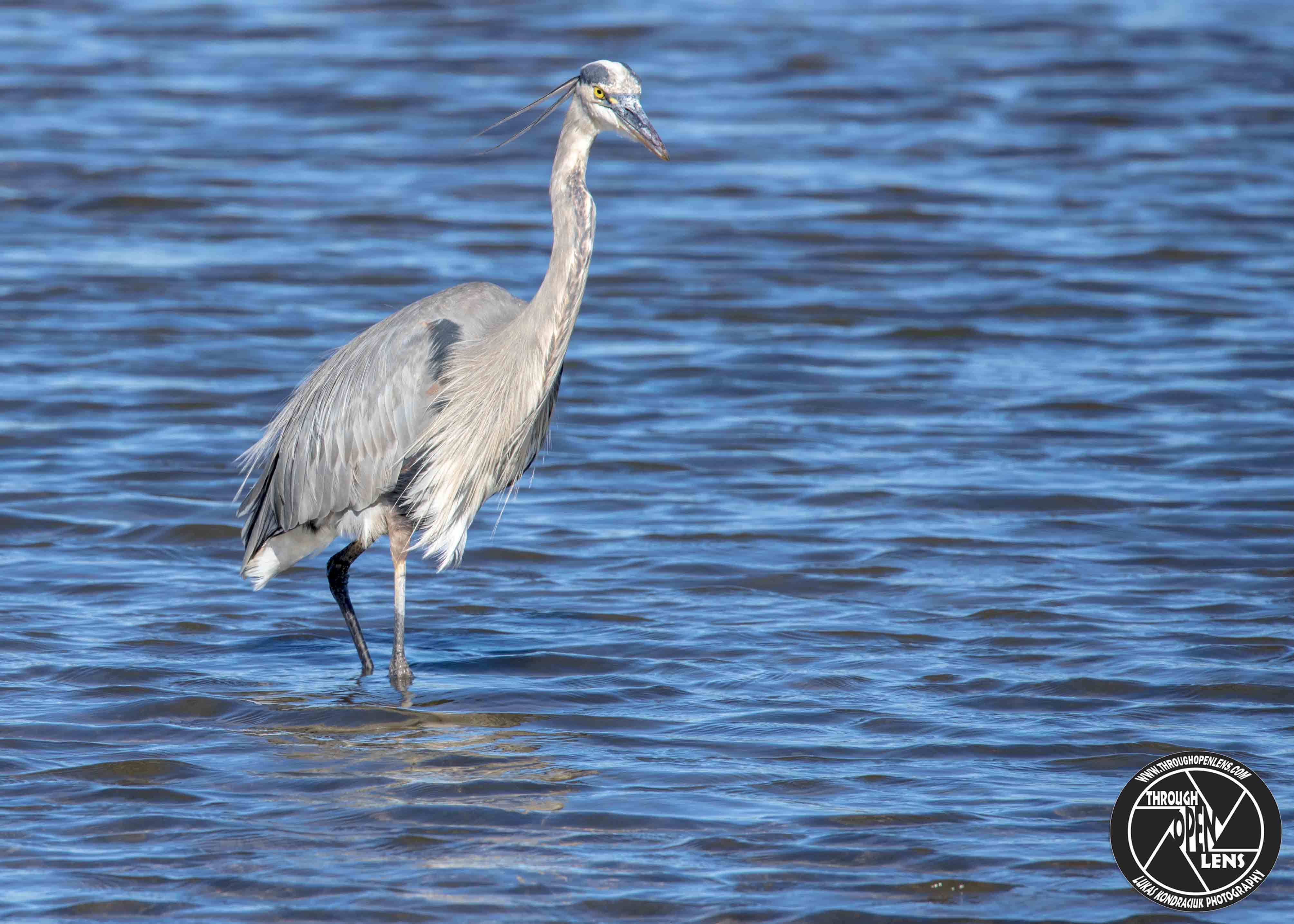
I Enjoy Long Romantic Walks On The Beach

F/10.0, 1/400, ISO 250.

Great Blue Heron 

Why did the fish blush?

Because it saw the ocean’s bottom.

Interesting Fact: Great Blue Herons forage, usually alone, across much of the U.S. This largest of the North American herons wades slowly or stands stock still, peering into the water for prey. In flight the Great Blue Heron folds it neck into an “S” shape and trails its long legs behind, dangling them as it prepares to land or when courting. ( https://www.allaboutbirds.org/guide/Great_Blue_Heron/lifehistory )