You Wanna To Go Bro!

F/7.1, 1/200, ISO 400.

Northern Flickers 

Who do you call when a giant fly attacks the city?

The SWAT team.

Interesting Fact: Nests are generally placed 6-15 feet off the ground, but on rare occasions can be over 100 feet high. Northern Flickers have been known to nest in old burrows of Belted Kingfishers or Bank Swallows. ( https://www.allaboutbirds.org/guide/Northern_Flicker/lifehistory )


Let Me Play In The Mud!

F/7.1, 1/200, ISO 160.

Semipalmated Sandpiper

What is the difference between erotic and kinky?

Erotic is using a feather… kinky is using the whole chicken.

Interesting Fact: Their breeding habitat is the southern tundra in Canada and Alaska near water. They nest on the ground. The male makes several shallow scrapes; the female chooses one and adds grass and other material to line the nest. The female lays 4 eggs; the male assists in incubation. After a few days, the female leaves the young with the male; the young feed themselves. ( https://en.wikipedia.org/wiki/Semipalmated_sandpiper )


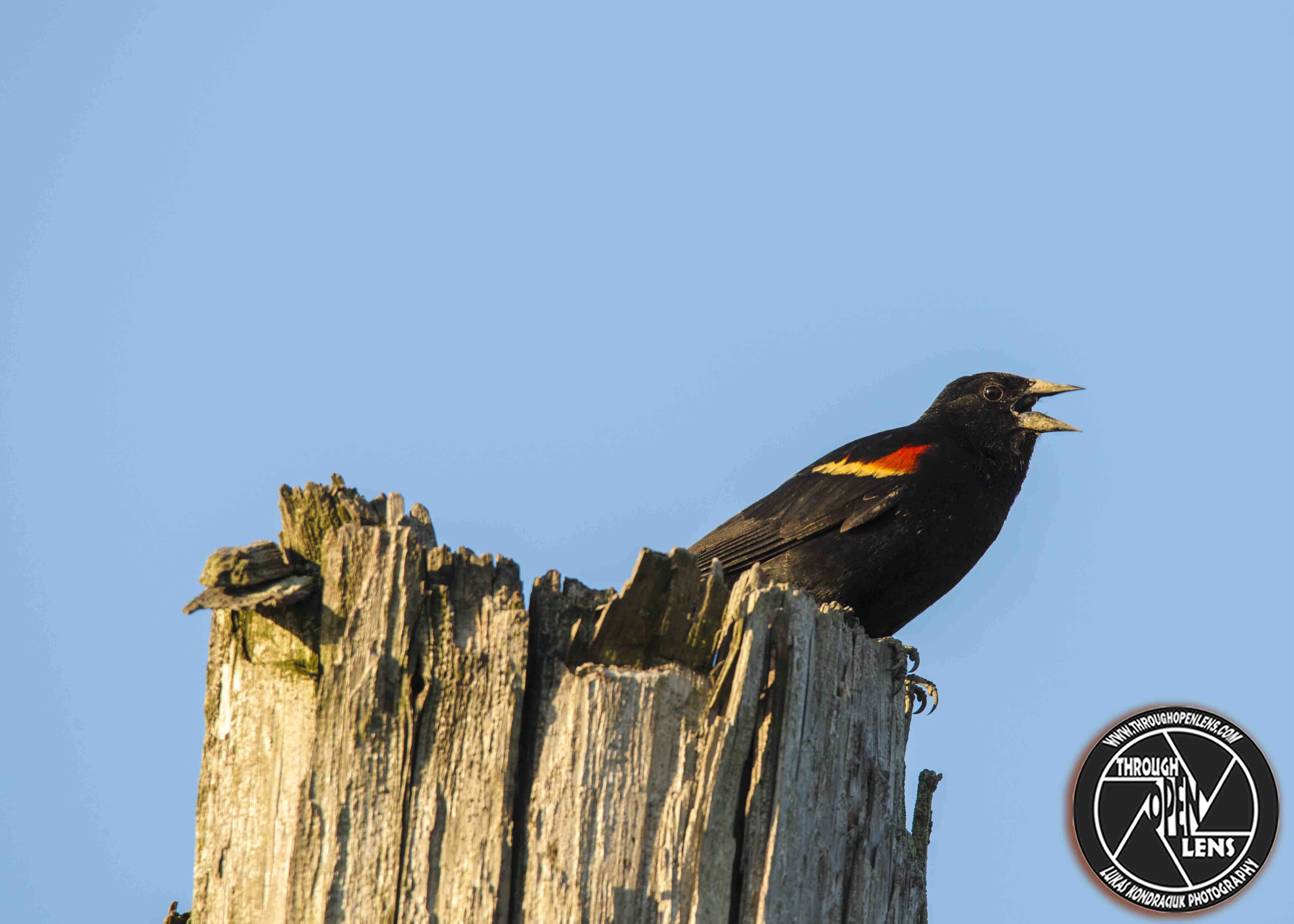
I Always Try To Cheer Myself Up By Singing When I Get Sad. Most Of The Time It Turns Out That My Voice Is Worst Then My Problems.

F/9.0, 1/320, ISO 250.

Red-winged Blackbird

What is the color of the wind?

Blew.

Interesting Fact: Different populations and subspecies of Red-winged Blackbirds vary markedly in size and proportions. An experiment was conducted that moved nestlings between populations and found that the chicks grew up to resemble their foster parents. This study indicated that much of the difference seen between populations is the result of different environments rather than different genetic makeups. ( https://www.allaboutbirds.org/guide/Red-winged_Blackbird/lifehistory  )


I Like This Head Bang Sh*t!

F/13.0, 1/640, ISO 320.

Red-Bellied Woodpecker

Why did the football coach go back to the bank?

To get his quarterback!

Interesting Fact: For birds that nest in cavities, nest holes are precious turf. Red-bellied Woodpeckers have been known to take over the nests of other birds, including the much smaller (and endangered) Red-cockaded Woodpecker. But more often they’re victims to the aggressive European Starling. As many as half of all Red-bellied Woodpecker nests in some areas get invaded by starlings. ( https://www.allaboutbirds.org/guide/Redbellied_Woodpecker/lifehistory )

Hee That Loves The Tree, Loves The Branch.

F/7.1, 1/200, ISO 1000.

Green Heron

What do you call an alligator in a vest?

An Investigator

Interesting Fact: Like many herons, the Green Heron tends to wander outside of its breeding range after the nesting season is over. Most of the wanderers stay nearby as they search for good feeding habitat, but some travel long distances. Individuals have turned up as far away as England and France. ( https://www.allaboutbirds.org/guide/Green_Heron/lifehistory )

I Only Have Crazy Eyes For You!

F/9.0, 1/320, ISO 320.

Northern Mockingbird 

Why don’t witches like to ride their brooms when they’re angry?

They’re afraid of flying off the handle!

Interesting Fact:  The Northern Mockingbird frequently gives a “wing flash” display, where it half or fully opens its wings in jerky intermediate steps, showing off the big white patches. No one knows why it does this, but it may startle insects, making them easier to catch. On the other hand, it doesn’t often seem to be successful, and different mockingbird species do this same display even though they don’t have white wing patches.  ( https://www.allaboutbirds.org/guide/Northern_Mockingbird/lifehistory )

I Am Too Busy Working On My Own Grass To Notice If Yours Is Greener

F/6.3, 1/250, ISO 640.

Muskrat

Why is sex like math?

You add a bed, subtract the clothes, divide the legs, and pray there’s no multiplying!

Interesting Fact: Muskrats provide an important food resource for many other animals, including minkfoxescoyoteswolveslynxbobcatsbearseaglessnakesalligators, and large owls and hawksOtterssnapping turtles, and large fish such as pike prey on baby muskrats. Caribou and elk sometimes feed on the vegetation which makes up muskrat push-ups during the winter when other food is scarce for them.[24] In their introduced range in the former Soviet Union, the muskrat’s greatest predator is the golden jackal. They can be completely eradicated in shallow water bodies, and during the winter of 1948–49 in the Amu Darya (river in central Asia), muskrats constituted 12.3% of jackal faeces contents, and 71% of muskrat houses were destroyed by jackals, 16% of which froze and became unsuitable for muskrat occupation. Jackals also harm the muskrat industry by eating muskrats caught in traps or taking skins left out to dry. ( https://en.wikipedia.org/wiki/Muskrat#Behavior )

Only The Bold Get To The Top.

F/8.0, 1/250, ISO 320.

Red-Eared Slider Turtles

Why did the nurse go to art school?

To learn how to draw blood!

Interesting Fact: Red-eared sliders are almost entirely aquatic, but as they are cold-blooded, they leave the water to sunbathe to regulate their temperature. ( https://en.wikipedia.org/wiki/Red-eared_slider )


That’s Not A Wild Goose Chase. That’s Bingo.

F/7.1, 1/200, ISO 400.

Domestic Geese in Wild

Which two letters in the alphabet are always jealous?

NV.

Interesting Fact: In Europe, northern Africa, and western Asia, the original domesticated geese are derived from the greylag goose Anser anser. In eastern Asia, the original domesticated geese are derived from the swan goose Anser cygnoides; these are commonly known as Chinese geese. Both have been widely introduced in more recent times, and modern flocks in both areas (and elsewhere, such as Australia and North America) may consist of either species, and/or hybrids between them. Chinese geese may be readily distinguished from European geese by the large knob at the base of the bill, though hybrids may exhibit every degree of variation between them. ( https://en.m.wikipedia.org/wiki/Domestic_goose )

Next Time I Am Wearing Green!

F/6.3, 1/ 160, ISO 320.

Chipping Sparrow

How do farmers party?

They turnip the beets.

Interesting Fact: The early naturalists had a gift for description you just don’t see anymore. In 1929, Edward Forbush called the Chipping Sparrow “the little brown-capped pensioner of the dooryard and lawn, that comes about farmhouse doors to glean crumbs shaken from the tablecloth by thrifty housewives.” ( https://www.allaboutbirds.org/guide/Chipping_Sparrow/lifehistory )