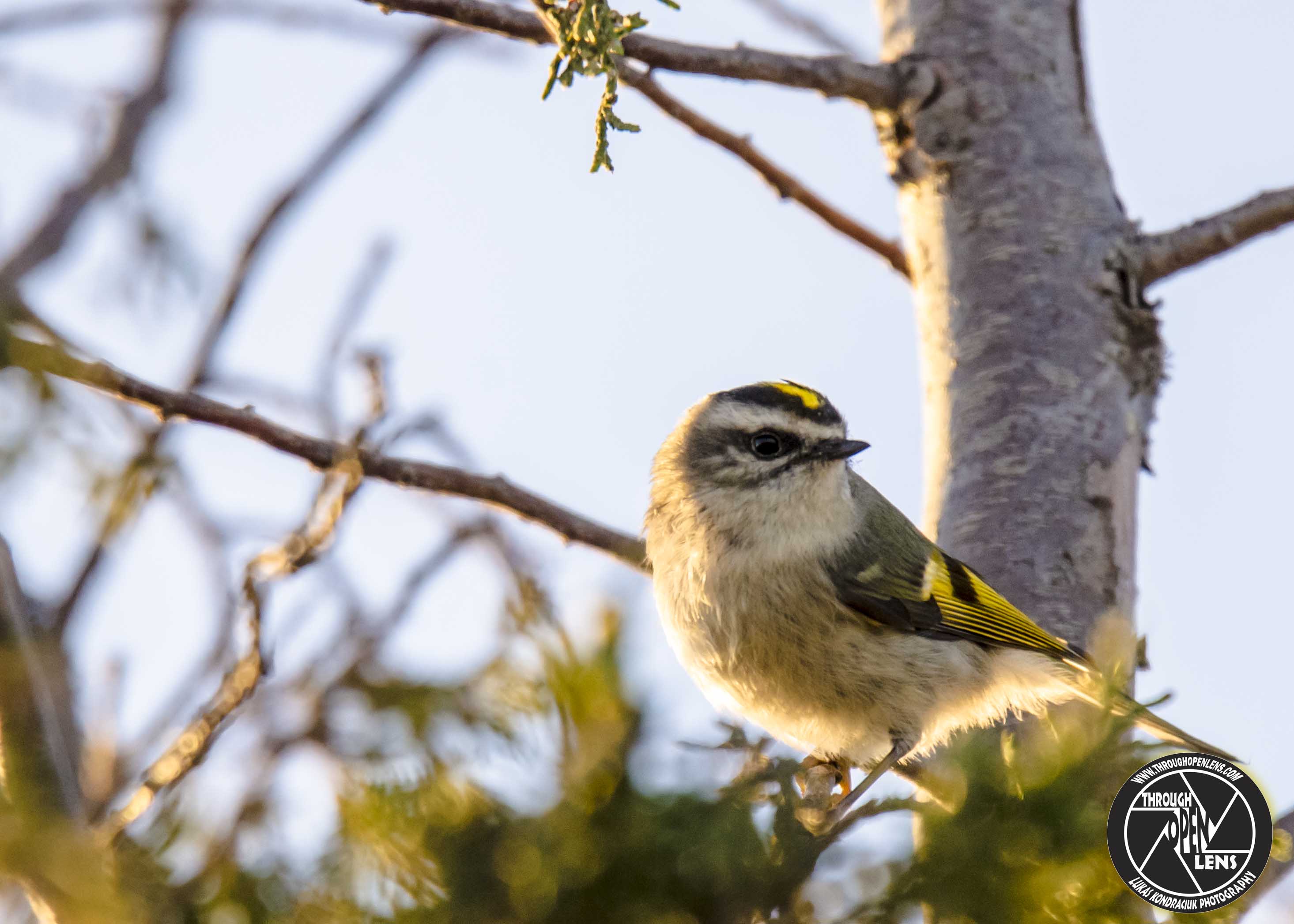
Who Do I Crap ON Today?

golden-crowned-kinglet

F/6.3, 1/500, ISO 800.

Golden-crowned Kinglet

Why are pirates so mean?

I don’t know, they just arrrrrrrrr!

Interesting Fact: The Golden-crowned Kinglet usually raises two large broods of young, despite the short nesting season of the northern boreal forest. The female feeds her first brood only up until the day after they leave the nest. She then starts laying the second set of eggs while the male takes care of the first brood. The male manages to feed eight or nine nestlings himself, and he occasionally feeds the incubating female too. ( https://www.allaboutbirds.org/guide/Golden-crowned_Kinglet/lifehistory )

Point Of View

white-breasted-nuthatch

F/8.0, 1/250, ISO 320.

White-breasted Nuthatch

How do you keep from getting cold feet?

Don’t go around BRRfooted!

Interesting Fact:  If you see a White-breasted Nuthatch making lots of quick trips to and from your feeder – too many for it to be eating them all – it may be storing the seeds for later in the winter, by wedging them into furrows in the bark of nearby trees. ( https://www.allaboutbirds.org/guide/White-breasted_Nuthatch/lifehistory )

I Have A Headache!

downy-woodpecker-4

F/8.0, 1/250, ISO 320.

Downy Woodpecker

Why did Adele cross the road?

To sing, “Hello from the other side!”

 Interesting Fact: Downy Woodpeckers have been discovered nesting inside the walls of buildings. ( https://www.allaboutbirds.org/guide/Downy_Woodpecker/lifehistory )

Well I’m going down, down, down, down, down, down.

mallard-landing

F/6.0, 1/500, ISO 360.

Mallard  

A Ham sandwich walks into a bar and asks the bartender for a drink.

The bartender says, “Sorry we don’t serve food.”

Interesting Fact:  The Mallard is the ancestor of nearly all domestic duck breeds (everything except the Muscovy Duck). Domestic ducks can be common in city ponds and can be confusing to identify—they may lack the white neck ring, show white on the chest, be all dark, or show oddly shaped crests on the head. ( https://www.allaboutbirds.org/guide/Mallard/lifehistory )

But I’m A Creep!

F/8.0, 1/250, ISO 320.

Brown Creeper

Why was Cinderella thrown off the basketball team?

She ran away from the ball.

Interesting Fact: Brown Creepers burn an estimated 4–10 calories (technically, kilocalories) per day, a tiny fraction of a human’s daily intake of about 2,000 kilocalories. By eating a single spider, a creeper gains enough energy to climb nearly 200 feet vertically. ( https://www.allaboutbirds.org/guide/Brown_Creeper )

Don’t Look At My Hole!

F/9.0, 1/320, ISO 160.

Hispaniolan Woodpecker

Why aren’t there any shark puppeteers?

They have no hands!

Interesting Fact: This woodpecker forages in small noisy groups; the diet is varied and includes insects, spiders, scorpions, lizards, fruit, seeds, grain and sap. It can catch flying insects on the wing, and larger food items are bashed on an “anvil” to break them up. ( https://en.wikipedia.org/wiki/Hispaniolan_woodpecker )

Be Yourself Because An Original Is Worht More Then A Copy!

F/10.0, 1/400, ISO 160.

White-winged Dove

What kind of candy do zombies refuse to eat?

LIFE Savers!

Interesting Fact: Like other doves and pigeons, White-winged Doves have some unusual abilities. They can suck and swallow water without moving their heads. And they use a secretion from the esophagus, known as crop milk, to feed nestlings. Both parents may consume snails and bone fragments to help their bodies create the nutritious fluid. ( https://www.allaboutbirds.org/guide/White-winged_Dove )

I Live In The Meow!

F/6.3, 1/60, ISO 320.

Gray Catbird

Why did the computer break up with the internet?

There was no “Connection”.

Interesting Fact:  The Gray Catbird’s long song may last for up to 10 minutes. ( https://www.allaboutbirds.org/guide/Gray_Catbird )

So Psyched To Head Bang Today!

F/10.0, 1/320, ISO 160.

Hispaniolan Woodpecker

What are three words you dread the most while making love?

“Honey, I’m home.”

Interesting Fact: Unlike most woodpeckers, the Hispaniolan woodpecker is a social species that takes advantage of having a large number of individual adult birds in the colony to protect a nesting bank or tree. There may be twenty pairs of birds in a colony, with several nesting in the same tree. The nests are excavated in trunks and branches, and discarded holes are reused by parrots, parakeets, trogons, the Antillean piculet and the golden swallow.https://en.wikipedia.org/wiki/Hispaniolan_woodpecker )

Chill With Me

F/6.3, 1/1000, ISO 450.

American Tree Sparrow 

Why don’t skeletons fight each other?

They don’t have the guts

Interesting Fact:  Misleadingly named by European settlers reminded of Eurasian Tree Sparrows back home, American Tree Sparrows are ground birds. They forage on the ground, nest on the ground, and breed primarily in scrubby areas at or above the treeline. ( https://www.allaboutbirds.org/guide/American_Tree_Sparrow/lifehistory )