Ride On Santa!

F/8.0, 1/250, ISO 100.

Merry Christmas And Happy Holidays To All

Santa Claus Horseback Riding

What did the Christmas tree say to the ornament?

Quit hanging around!

Interesting Fact: In the Early Middle Ages, Christmas Day was overshadowed by Epiphany, which in western Christianity focused on the visit of the magi. But the medieval calendar was dominated by Christmas-related holidays. The forty days before Christmas became the “forty days of St. Martin” (which began on November 11, the feast of St. Martin of Tours), now known as Advent.[83] In Italy, former Saturnalian traditions were attached to Advent.[83] Around the 12th century, these traditions transferred again to the Twelve Days of Christmas (December 25 – January 5); a time that appears in the liturgical calendars as Christmastide or Twelve Holy Days. ( https://en.wikipedia.org/wiki/Christmas#History )

 

What Would You Like For Christmas?

F/5.6, 1/100, ISO 320.

Happy Christmas Eve Everyone

Santa Claus

What do you call a kid who doesn’t believe in Santa?

A rebel without a Claus!

Interesting Fact: Santa Claus is generally depicted as a portly, jolly, white-bearded man—sometimes with spectacles—wearing a red coat with white fur collar and cuffs, white-fur-cuffed red trousers, red hat with white fur, and black leather belt and boots and carrying a bag full of gifts for children. This image became popular in the United States and Canada in the 19th century due to the significant influence of the 1823 poem “A Visit from St. Nicholas” and of caricaturist and political cartoonist Thomas Nast.[2][3][4] This image has been maintained and reinforced through song, radio, television, children’s books, films, and advertising.  ( https://en.wikipedia.org/wiki/Santa_Claus )


What Drives You Nuts?!

F/6.3, 1/100, ISO 320.

American Red Squirrel

Why do squirrels swim on there back?

To keep their nuts dry!

Interesting Fact: Red squirrels can be easily distinguished from other North American tree squirrels by their smaller size, 28–35 cm (11–14 in) total length (including tail), territorial behavior, and reddish fur with a white venter (underbelly).[6] Red squirrels are somewhat larger than chipmunks. The Douglas squirrel is morphologically similar to the American red squirrels, but has a rust-colored venter and is restricted to the southwestern coast of British Columbia and in the Pacific Northwest of the United States. These species’ ranges do not overlap.  ( https://en.wikipedia.org/wiki/American_red_squirrel )

With The New Day Comes New Strength And New Thoughts

F/11.0, 1/500, ISO 400.

Cedar Waxwing

What do you call a cow that eats your grass?

A lawn moo-er.

Interesting Fact: The name “waxwing” comes from the waxy red secretions found on the tips of the secondaries of some birds. The exact function of these tips is not known, but they may help attract mates. ( https://www.allaboutbirds.org/guide/Cedar_Waxwing/lifehistory )

I Give Out Swimming Lessons

F/8.0, 1/250, ISO 640.

Double-crested Cormorant

What do you call a bear with no socks on?

Bare-foot.

Interesting Fact: Large pebbles are occasionally found in cormorant nests, and the cormorants treat them as eggs. ( https://www.allaboutbirds.org/guide/Double-crested_Cormorant )

Swim At Your Own Risk

mute-swan-swimming

F/5.6, 1/125, ISO 320.

Mute Swan

Why did the teacher jump into the water?

She wanted to test the water!

Interesting Fact: The black knob at the base of the male Mute Swan’s bill swells during the breeding season and becomes noticeably larger than the female’s. The rest of the year the difference between the sexes is not obvious.  ( https://www.allaboutbirds.org/guide/Mute_Swan/lifehistory )

Change Is Hard. Have You Ever Tried To Bend A Coin?

F/7.1, 1/200, ISO 160.

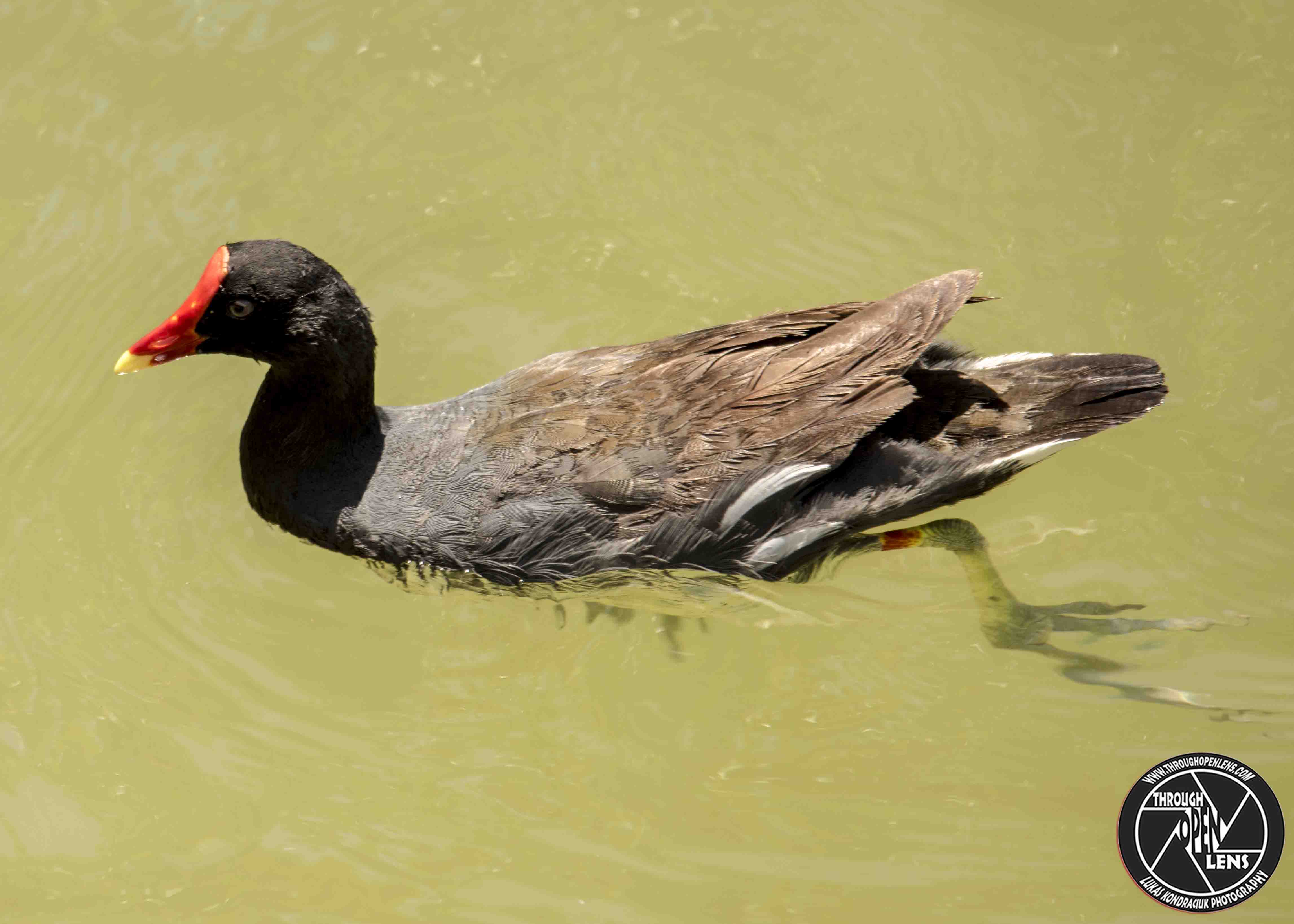
Common Gallinule

Why didn’t the skeleton go to the dance?

Because he had no-body to go with

Interesting Fact: Common Gallinules build nests to raise their young, but they also build platforms of matted vegetation to display for potential mates. ( https://www.allaboutbirds.org/guide/Common_Gallinule )

Don’t Forget To Set Your Scales Back 15 lbs Tonight.

F/6.3, 1/50, ISO 500.

Wild Turkey Male

What happened then the Turkey got into a fight?

He got the stuffing knocked out of him.

Interesting Fact: They display for females by strutting with their tails fanned, wings lowered, while making nonvocal hums and chump sounds. Males breed with multiple mates and form all-male flocks outside of the breeding season, leaving the chick-rearing to the females, The chicks travel in a family group with their mother, often combining with other family groups to form large flocks of young turkeys accompanied by two or more adult females. ( https://www.allaboutbirds.org/guide/Wild_Turkey/lifehistory )


Got An Itch That I Can’t Reach!

F/10.0, 1/400, ISO 320.

Mallard

What do you call a duck that steals?

A robber ducky.

Interesting Fact: Mallards nest on the ground on dry land that is close to water; nests are generally concealed under overhanging grass or other vegetation. Occasionally, Mallards nest in agricultural fields, especially alfalfa but also winter wheat, barley, flax, and oats. Both urban and wild populations readily nest in artificial nesting structures. Pairs search for nest sites together, typically on evening flights circling low over the habitat. Occasionally nests are placed on floating mats of vegetation or woven into plant stems that rise out of the water. ( https://www.allaboutbirds.org/guide/Mallard/lifehistory )

Don’t Look Back With Regret, Look Foward With Hope.

F/10.0, 1/400, ISO 160.

Black-capped Chickadee

What do you call a gorilla wearing ear-muffs?

Anything you like! He can’t hear you!

Interesting Fact: There is a dominance hierarchy within flocks. Some birds are “winter floaters” that don’t belong to a single flock—these individuals may have a different rank within each flock they spend time in. ( https://www.allaboutbirds.org/guide/Black-capped_Chickadee/lifehistory