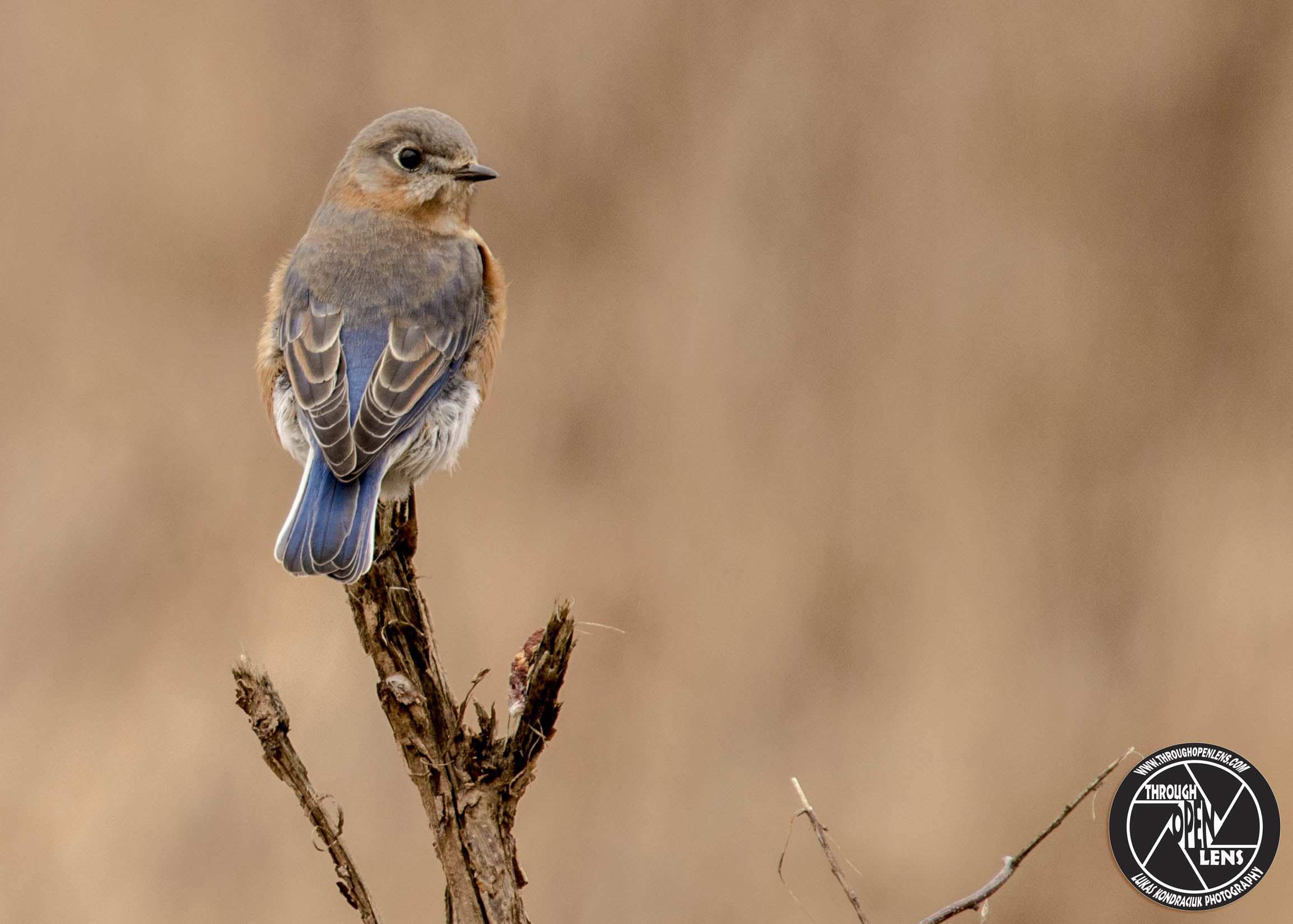
You’re My Boy Blue!

F/7.1, 1/200, ISO 400.

Eastern Bluebird

Why don’t they play poker in the jungle?

Too many cheetahs.

Interesting Fact: This small, brightly colored thrush typically perches on wires and fence posts overlooking open fields. The birds forage by fluttering to the ground to grab an insect, or occasionally by catching an insect in midair. Bluebirds can sight their tiny prey items from 60 feet or more away. They fly fairly low to the ground, and with a fast but irregular pattern to their wingbeats. ( https://www.allaboutbirds.org/guide/Eastern_Bluebird/lifehistory )


Let’s Dance!

F/10.0, 1/400, ISO 320.

Greater Yellowlegs & Green-Winged Teal Duck ( Female ) 

Why did the Vampire get fired from the Blood Bank?

He was caught drinking on the job.

Interesting Fact: The Greater Yellowlegs walks with a distinctive high-stepping gait across wetlands when foraging, occasionally dashing forward in pursuit of a prey item. Compared to other shorebirds, the Greater Yellowlegs is often rather solitary. ( https://www.allaboutbirds.org/guide/Greater_Yellowlegs/lifehistory )


You Can’t Make Everybody Happy. You’re Not Pizza!

F/8.0, 1/250, ISO 250.

Dark-Eyed Junco  

Why aren’t there any famous skeletons?

They’re a bunch of no bodies.

Interesting Fact: When foraging, Dark-eyed Juncos typically hop (rather than walk) on the ground, pecking or scratching at the leaf litter, or flit very low in underbrush gleaning food from twigs and leaves. They sometimes fly up from the ground to catch insects from tree trunks. ( https://www.allaboutbirds.org/guide/Dark-eyed_Junco/lifehistory )


I’m Feeling A Little Froggy!

F/6.3, 1/50, ISO 500.

Southern Leopard Frog

Want to hear a dirty joke?

The white horse fell in the mud.

Interesting Fact: This frog lives in many types of shallow freshwater habitat and sometimes in slightly brackish water. It is usually found close to water but it can stay on dry land for long periods of time.[8] During warmer months it moves away from the water for most of the time.[10] It is mostly nocturnal,[10] but it can be active during the day and the night, especially during rainfall. It breeds in the winter and spring, and sometimes in the fall; heavy periods of rainfall trigger breeding.[8] The egg mass is connected to aquatic vegetation.[9] It typically nests communally in cooler weather, and individually in warmer weather.[11][12] Eggs hatch in 4 days to nearly two weeks.[10] The tadpoles take 50 to 75 days to develop to adulthood. ( https://en.wikipedia.org/wiki/Southern_leopard_frog )

I Chill Harder Than You Party!

F/ 6.3, 1/60, ISO 320.

Wood Duck

What are those things you blow on and make wishes?

Breathalyzers

Interesting Fact: They are strong fliers and can reach speeds of 30 mph. Wood Ducks are not territorial, with the exception that a male may fight off other males that approach his mate too closely.  ( https://www.allaboutbirds.org/guide/Wood_Duck/lifehistory )

I Like To Hang Out With People Who Makes Me Forget To Look At My Phone.

F/9.0, 1/320, ISO 200.

Sandhill Crane

Why was the Police officer standing on poop?

He was On-Duty.

Interesting Fact: Although each female usually lays two eggs, only one nestling typically survives to fledge. Mated pairs and their juvenile offspring stay together all through the winter, until the 9- to 10-month-old juveniles finally separate from their parents the following spring. During migration and winter the family units group together with other families and nonbreeders, forming loose roosting and feeding flocks—in some places numbering in the tens of thousands. ( https://www.allaboutbirds.org/guide/Sandhill_Crane/lifehistory )


I Feel Proud To Be A Bird!

F/10.0, 1/400, ISO 400.

Yellow-Rumped Warbler

What’s a vampire’s favorite fruit?

Neck-tarine

Interesting Fact: In winter, Yellow-rumped Warblers join flocks and switch to eating berries from fruiting shrubs. Sometimes the flocks are enormous groups consisting entirely of Yellow-rumped Warblers. If another bird gets too close, Yellow-rumped Warblers indicate the infraction by holding the body horizontally, fanning the tail, and raising it to form a right angle with its body. ( https://www.allaboutbirds.org/guide/Yellow-rumped_Warbler/lifehistory )

Nooo! Why Did She Have To Do Laundry Day!

friday-13th

Have A Killer Weekend!

F/5.6, 1/60, ISO 160.

What song does Jason Voorhees sing on Friday the 13th?

“Takin Care of Business”

Interesting Fact:

The fear of the number 13 has been given a scientific name: “triskaidekaphobia“; and on analogy to this the fear of Friday the 13th is called paraskevidekatriaphobia, from the Greek words Paraskeví (Παρασκευή, meaning “Friday”), and dekatreís (δεκατρείς, meaning “thirteen”).[4]The Last Supper by Leonardo da Vinci

The superstition surrounding this day may have arisen in the Middle Ages, “originating from the story of Jesus’ last supper and crucifixion” in which there were 13 individuals present in the Upper Room on the 13th of Nisan Maundy Thursday, the night before his death on Good Friday.[5][6] While there is evidence of both Friday[7] and the number 13 being considered unlucky, there is no record of the two items being referred to as especially unlucky in conjunction before the 19th century. ( https://en.wikipedia.org/wiki/Friday_the_13th )

I Know A Morse Code!

F/6.3, 1/640, ISO 2200.

Yellow-Bellied Sapsucker

Why are gold fish orange?

The water makes them rusty!

Interesting Fact: The Yellow-bellied Sapsucker is the only woodpecker in eastern North America that is completely migratory. Although a few individuals remain throughout much of the winter in the southern part of the breeding range, most head farther south, going as far south as Panama. Females tend to migrate farther south than do males. ( https://www.allaboutbirds.org/guide/Yellow-bellied_Sapsucker/overview )

Just Letting Out A Little Steam!

F/13.0, 1/640, ISO 250.

Albuquerque International Balloon Fiesta

Why are politicians like diapers?

Both should be changed regularly and for the same reason.

Interesting Fact: In the 18th century the Portuguese Jesuit priest Bartolomeu de Gusmão envisioned an aerial apparatus called Passarola which was the predecessor of the hot air balloon. The purpose of Passarola was to serve as air vessel in order to facilitate communication and as a strategical device.[5] In 1709 John V of Portugal decided to fund Bartolomeu de Gusmão’s project following a petition made by the Jesuit priest [6] and an unmanned demonstration was performed at Casa da India in presence of John V, the queen Maria Anna of Austria, having as witnesses the Italian cardinal Michelangelo Conti, two members of the Portuguese Royal Academy of History, one Portuguese diplomat and one chronicler. This event would bring some European attention to this event and this project. A later article dated on October 20, 1786 by the London Daily Universal Register would state that the inventor was able to raise himself by the use of his prototype. Also in 1709, the Portuguese Jesuit wrote Manifesto summário para os que ignoram poderse navegar pelo elemento do ar (Short Manifesto for those who are unaware that is possible to sail through the element air); he also left designs for a manned air vessel. ( https://en.wikipedia.org/wiki/Hot_air_balloon )