It’s Your Hair Do Whatever You Want!

F/6.3, 1/500, ISO 200.

Hooded Merganser ( Female )

How do ducks talk?

They don’t You Quack.

Interesting Fact: The female chooses the nest site, and may start scouting for next year’s tree cavity at the end of each breeding season. Nest cavities can be in live or dead trees and are usually close to water. Cavities are typically 10–50 feet off the ground, up to about 90 feet. Hooded Mergansers nest readily in boxes, preferring those with wood shavings or nest material from previous uses. They prefer cavities with 3–5 inch openings. ( https://www.allaboutbirds.org/guide/Hooded_Merganser/lifehistory

Work, Really? Agian? Didn’t I Just Do That Yesturday?!

F/9.0, 1/320, ISO 160.

Sandhill Crane

What do Snowmen call their offspring?

Chill-dren.

Interesting Fact: Sandhill Cranes mate for life, choosing their partners based on dancing displays. Displaying birds stretch their wings, pump their heads, bow, and leap into the air.  ( https://www.allaboutbirds.org/guide/Sandhill_Crane/lifehistory )

I Lost My Temper, But It Came Back!

F/9.0, 1/250, ISO 160.

Ring-necked Duck

Why did the cookie go to the hospital?

He felt crummy!

Interesting Fact: Ring-necked Ducks feed by diving underwater, rather than by tipping up as “dabbling” ducks do. When diving, they leap forward in an arc to plunge underwater, and they swim using only their feet for propulsion. ( https://www.allaboutbirds.org/guide/Ring-necked_Duck/lifehistory )


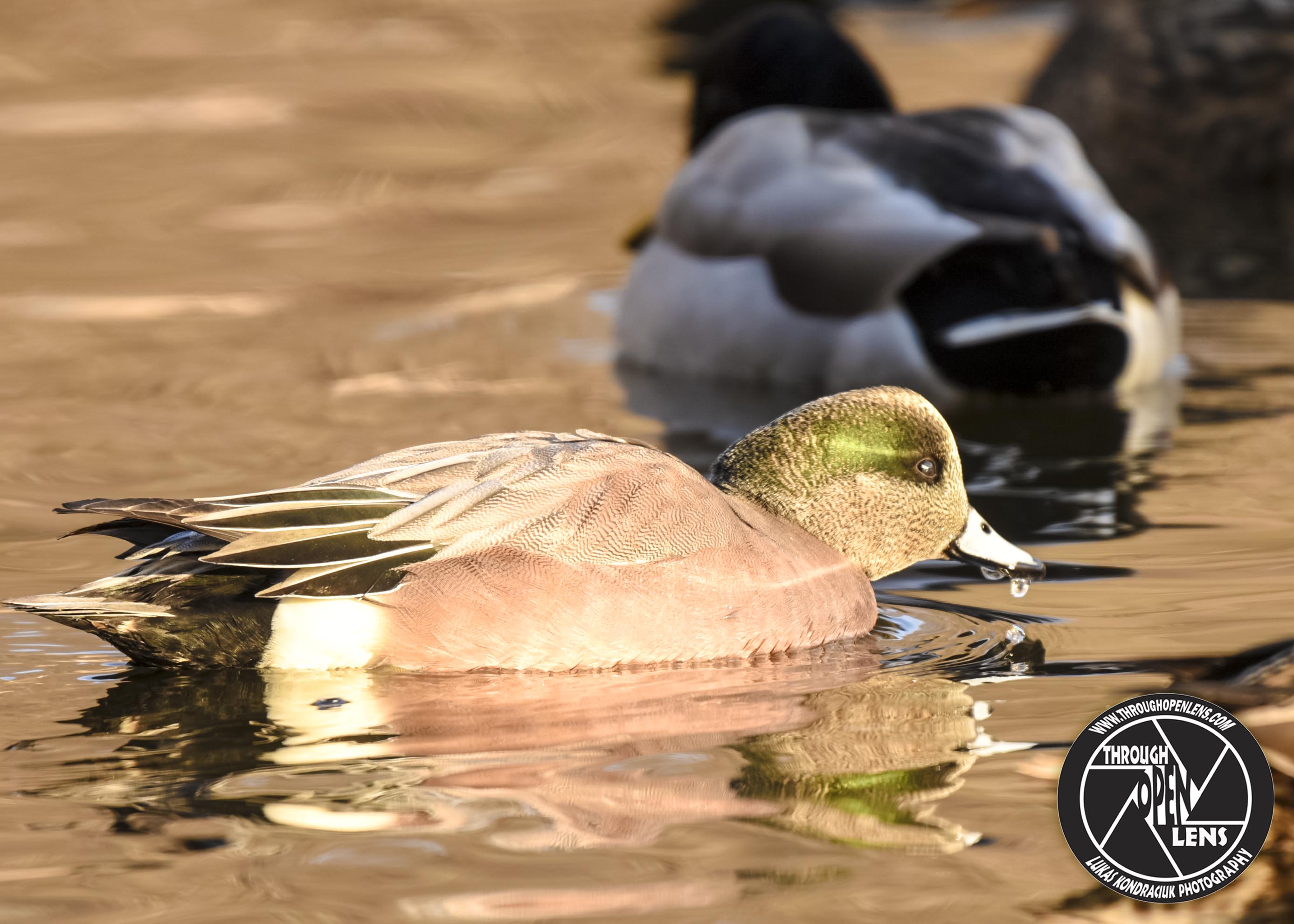
My Nose Has Done More Running This Winter Than I Have.

american-wigeon

F/7.1, 1/200, ISO 320.

American Wigeon

I went to a really emotional wedding over the weekend.

Even the cake was in tiers.

Interesting Fact: The American Wigeon’s short bill enables it to exert more force at the bill tip than other dabbling ducks, thus permitting efficient dislodging and plucking of vegetation.  ( https://www.allaboutbirds.org/guide/American_Wigeon/lifehistory )

If The Mud Ain’t Flying You Ain’t Trying!

F/9.0, 1/320, ISO 320.

Northern Pintail Duck

How do crazy people go through the forest?

They take the psycho path.

Interesting Fact: When it comes to breeding, Northern Pintails don’t waste any time. They start nesting as soon as the ice starts to thaw, arriving by late April in places as far north as the Northwest Territories, Canada. ( https://www.allaboutbirds.org/guide/Northern_Pintail/ )

Owl We Need Is Love!

F/6.3, 1/160, ISO 800.

Short Eared Owl

What kind of flower doesn’t sleep at night?

The Day-zzz

Interesting Fact: Normally reluctant to leave the nest, female Short-eared Owls that are forced to flush often defecate on their eggs. The resulting putrid smell may repel predators or mask the scent of the nest. ( https://www.allaboutbirds.org/guide/Short-eared_Owl/ )

CANNONBALL!!!!!!

F/8.0, 1/2000, ISO 800.

Common Merganser

What did the pencil say to the other pencil?

your looking sharp.

Interesting Fact: Common Mergansers spend the breeding season in northern forested habitats near large lakes and rivers. Since they nest in cavities of large trees, breeding Common Mergansers are usually found in mature forests. They spend winters on large lakes, rivers, and reservoirs in the southern and coastal regions of their breeding range, and in additional wintering grounds across the northern and western United States. They tend to prefer freshwater wintering habitat over saltwater, but they may winter in coastal bays, estuaries, and harbors. ( https://www.allaboutbirds.org/guide/Common_Merganser/lifehistory )

Don’t Stick Your Beak Where It Doesn’t Belong!

F/6.3, 1/6, ISO 100.

Great Blue Heron

Why couldn’t the pirate play cards?

Because he was sitting on the deck!

Interesting Fact: Great Blue Herons generally move away from the northern edge of their breeding range in winter, with some flying as far south as the Caribbean. Populations in the Pacific Northwest and south Florida are present year-round.  ( https://www.allaboutbirds.org/guide/Great_Blue_Heron/maps-range )


I’m Not Trying To Impress You Or Anything, But I Can Swim Without Floaties.

western-grebe-1

F/7.1, 1/800, ISO 200.

Western Grebe

A man was stranded on a desert island for 10 years.
One day a beautiful girl swims to shore in a wet suit.
Man: “Hi! Am I ever happy to see you.”!
Girl: “Hi! It seems like you’ve been here along time. How long has it been since you’ve had a cigarette?”
Man: “It’s been ten years!”
With this information the girl unzips a slot on the arm of her wet suit and gives the man cigarette.
Man: “Oh thank you so much!”
Girl: “So tell me how long its been since you had a drink?”
Man: “It’s been ten years” The girl unzips a little longer zipper on her wet suit and comes out with a flask of whiskey and gives the man a drink.
Man: “Oh. Thank you so much. You are like a miracle”!
Finally the girl starts to unzip the front of her wet suit and asks the man leadingly, “So tell me then, have you been bored?”
The man looked at her and said excitedly: “Oh, my God, don’t tell me you’ve got a surfboard in there too?”


Interesting Fact: Western Grebes breed on freshwater lakes and marshes with extensive open water bordered by emergent vegetation. During winter they move to saltwater or brackish bays, estuaries, or sheltered sea coasts and are less frequently found on freshwater lakes or rivers. ( https://www.allaboutbirds.org/guide/Western_Grebe/lifehistory )

Don’t Be A Creep!

F/8.0, 1/250, ISO 320.

Brown Creeper

Past, present and future walk into a bar.

It was tense!

Interesting Fact: The Brown Creeper spends most of its time spiraling up tree trunks in search of insects. It holds its short legs on either side of its body, with the long, curved claws hooking into the bark, and braces itself with its long, stiff tail. Both feet hop at the same time, making the bird’s head duck after each hop. Because of its specialized anatomy, the Brown Creeper rarely climbs downward: once high in a tree, it flies down to begin a new ascent at the base of a nearby tree. ( https://www.allaboutbirds.org/guide/Brown_Creeper/lifehistory )