Do We Have A Problem Here!

F/6.3, 1/640, ISO800.

American Black Duck

What says “Quick, Quick”?

A duck with the hiccups.

Interesting Fact: If a mother is killed or separated from her brood, another Black Duck with ducklings of her own, regardless of their age, will quickly adopt the orphans. ( http://identify.whatbird.com/obj/392/_/American_Black_Duck.aspx )

Shhhh…. I’m Hiding!

F/ 5.6, 1/250, ISO 720.

Mallard

What does a duck do first when making an omelet?

He quacks some eggs.

Interesting Fact: The widespread Mallard has given rise to a number of populations around the world that have changed enough that they could be considered separate species. The “Mexican Duck” of central Mexico and the extreme southwestern United States and the Hawaiian Duck both are closely related to the Mallard, and in both forms the male is dull like the female. The Mexican Duck currently is considered a subspecies of the Mallard, while the Hawaiian Duck is still given full species status. ( https://www.allaboutbirds.org/guide/Mallard/lifehistory )

Keep Calm And Quack Quack!

F/11.0, 1/500, ISO 500.

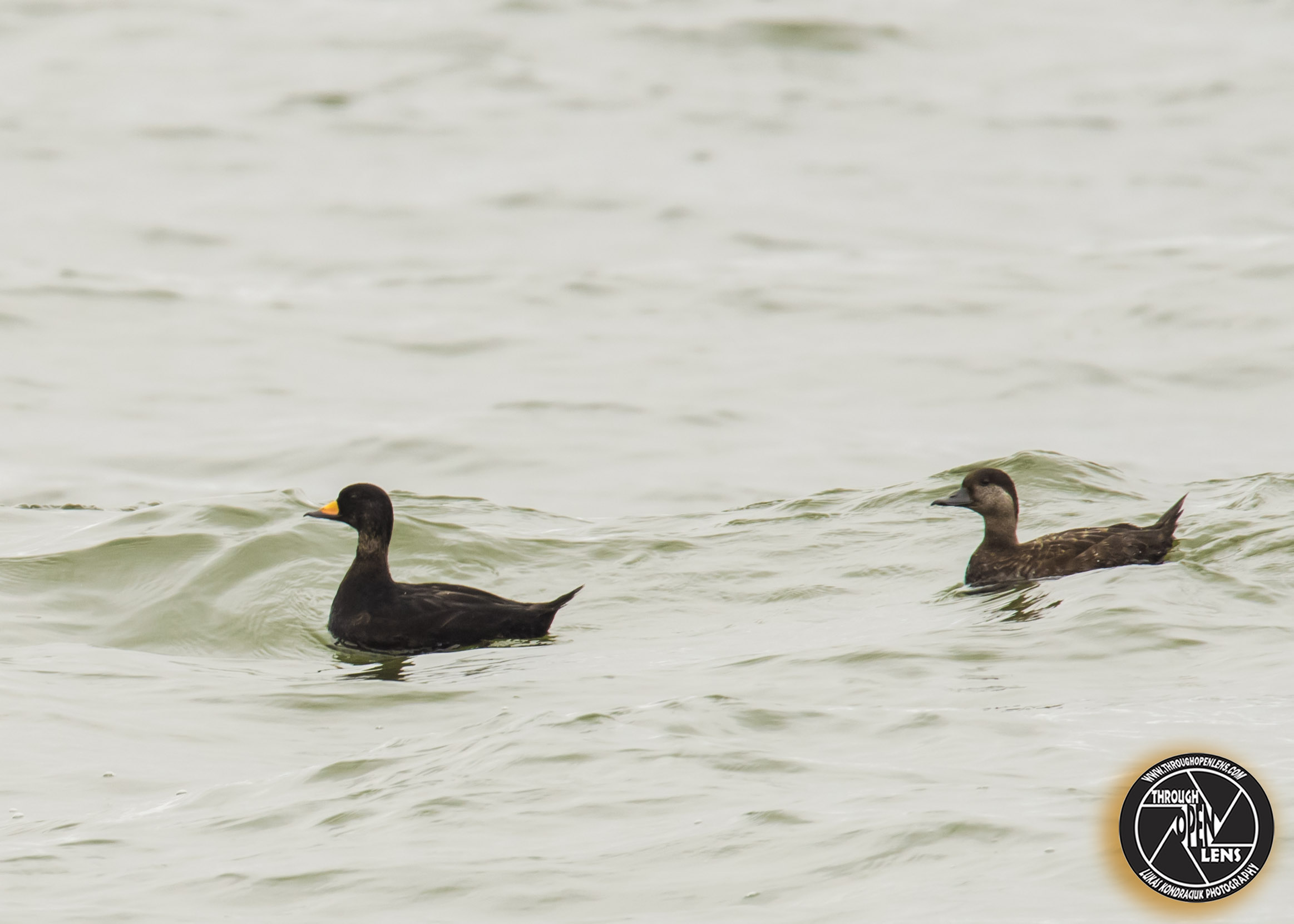
Black Scoter

Mother: What did you learn in school today

Son: How to write.

Mother: What did you write?

Son: I don’t know, they haven’t taught us how to read yet!

Interesting Fact: The Black Scoter is divided into two subspecies. In the form found in Europe, the “Common Scoter,” the male has a larger swollen knob at the base of the upper bill that is black on the sides with a yellow stripe on top, not entirely yellow. ( https://www.allaboutbirds.org/guide/Black_Scoter/lifehistory )


Eat Pasta Swim Fasta!

F/7.1, 1/200, ISO 200.

Black Scoter Duck

Want to hear a construction joke?

Oh never mind, I’m still working on that one.

Interesting Fact: The lined nest is built on the ground close to the sea, lakes or rivers, in woodland or tundra. 5–7 eggs are laid. Each eggs weighs from 60–74 g (2.1–2.6 oz), or 8% of the females body weight. The incubation period may range from 27 to 31 days. Females brood their young extensively for about 3 weeks, after which the still flightless young must fend for themselves. ( https://en.wikipedia.org/wiki/Black_scoter )

I Think We’re Going To Need A Bigger Rock!

F/5.6, 1/500, ISO 200.

American Black Ducks ( Juveniles )

Why can’t you trust an atom?

Because they make up everything.

Interesting Fact:  Normally found in eastern North America, American Black Ducks occasionally show up on the West Coast, Europe, and even Asia. Some of these birds may be escaped pets, but others are known to be wild ducks: for instance, one female banded in New Brunswick, Canada, turned up later in France. ( https://www.allaboutbirds.org/guide/American_Black_Duck/lifehistory )


Double Take!

F/8.0, 1/250, ISO 250.

White-Cheeked Pintail

What kind of water do you put into a waterbed?

Spring water.

Interesting Fact: It is found in the CaribbeanSouth America, and the Galápagos Islands.[4] It occurs on waters with some salinity, such as brackish lakes, estuaries and mangrove swamps. ( https://en.wikipedia.org/wiki/White-cheeked_pintail )

PAUSE For A Moment And REFLECT

F/9.0, 1/320, ISO 320.

Red breasted Merganser 

What did E.T.’s mother say to him when he got home?

Where on Earth have you been?

Interesting Fact: The female creates a depression on the ground that she covers with dead grasses, forming a shallow bowl. She plucks down feathers from her breast to help insulate the nest. ( https://www.allaboutbirds.org/guide/Red-breasted_Merganser/lifehistory )


Always Be Yourself… Unless You Can Be A Duck… Then Always Be A Duck.

F/8.0, 1/250, ISO 200. 

Red-breasted Merganser 

Two men meet on opposite sides of a river.

One shouts to the other, “I need you to help me get to the other side!”

The other guy replies, “You’re on the other side!”

Interesting Fact: Red-breasted Mergansers are among the fastest flying ducks, clocking speeds of up to 81 miles per hour.  ( https://www.allaboutbirds.org/guide/Red-breasted_Merganser/lifehistory )


Welcome To The Duck Side. We Have Quackers.

F/9.0, 1/320, ISO 320.

Ruddy Duck 

Why didn’t my girlfriend believe I was a ghost?

She could see right through me.

Interesting Fact:  The nest is usually made of dead, dry plant materials, though some are built entirely with green vegetation. It starts as a platform and becomes more bowl-like throughout the construction process, with an inner cup measuring 4–12 inches across and 0.5–5 inches deep. Ruddy Ducks usually weave a canopy of vegetation over their nests. ( https://www.allaboutbirds.org/guide/Ruddy_Duck/lifehistory )

Bad Hair Day: Ain’t Nobody Got Time For That!

F/9.0, 1/320, ISO 200.

Red-breasted Mergansers 

Can February March?

No, but April May.

Interesting Fact:Red-breasted Mergansers nest along forested riverbanks, marsh edges, lakeshores, coastal islands, and sandy shores with vegetation. They are never far from water. Female Red-breasted Mergansers select a spot on the ground under dense cover from low tree branches, fallen logs, or boulders. They nest alone or in colonies often with gulls and terns. ( https://www.allaboutbirds.org/guide/Red-breasted_Merganser/lifehistory )