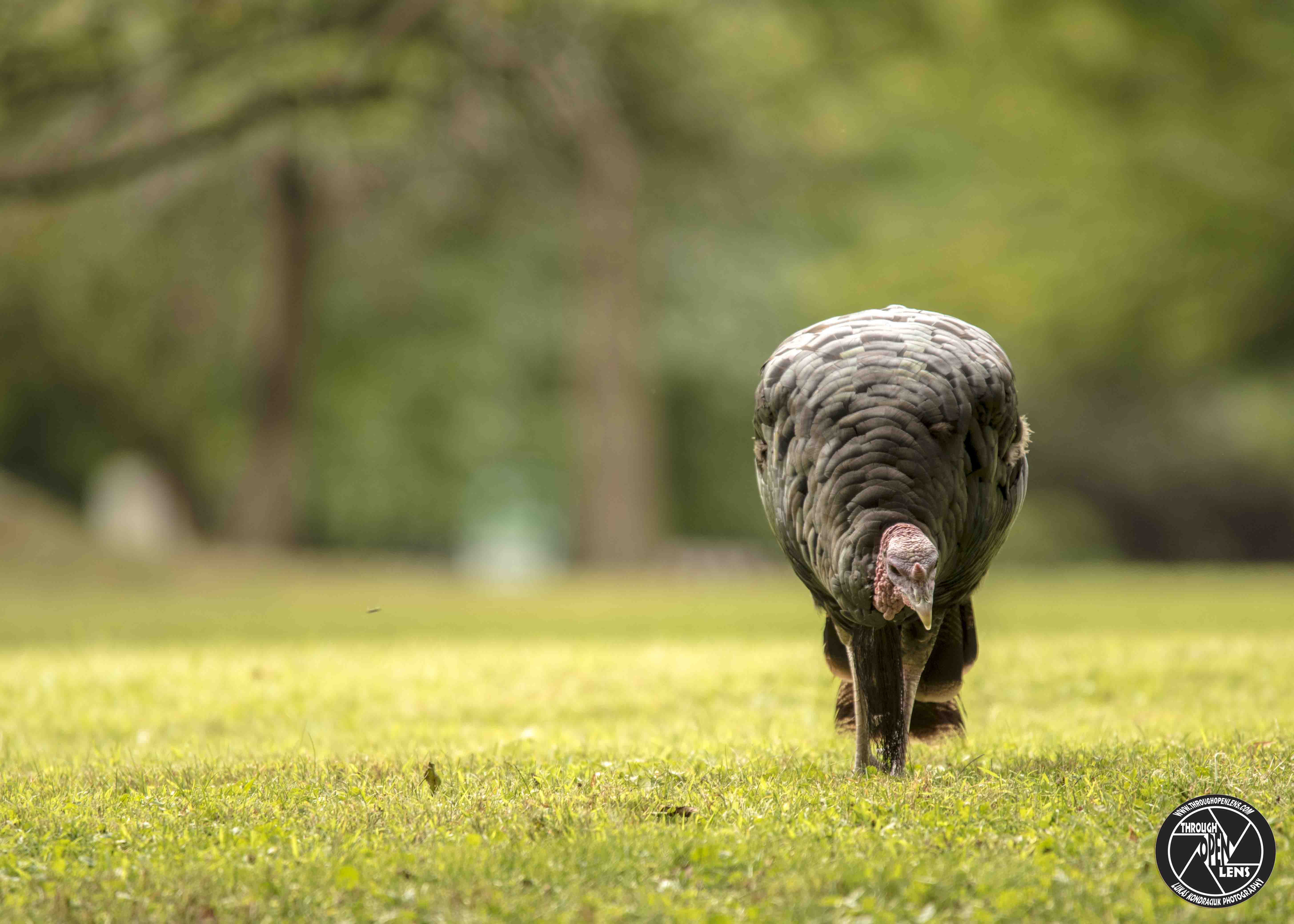
I Am Not A Patient Person

F/7.1, 1/160, ISO 320.

Wild Turkey 

How do you make an egg laugh?

Tell it a yolk.

Interesting Fact: Despite their weight, wild turkeys, unlike their domesticated counterparts, are agile, fast fliers. In ideal habitat of open woodland or wooded grasslands,[20] they may fly beneath the canopy top and find perches. They usually fly close to the ground for no more than 400 m (a quarter mile). ( https://en.wikipedia.org/wiki/Wild_turkey )


Aren’t You A Social Butterfly

F/8.0, 1/250, ISO 100.

Butterfly

How do you make a butterfly?

Flick it out of the butter dish with a knife!

Interesting Fact: Actually, butterflies do not eat at all. Well, at least not in the traditional sense. What do butterflies eat? Instead of eating, butterflies get their nurishment from drinking. They have a long narrow tube in their mouth called a proboscis that acts as a straw. They usually set on top of a flower and drink the nectar. To see a congregation of many kinds of butterflies together they feed on small puddles on the grouind or wet areas on leaves and plants. See the section below if you are interested in what Caterpillars eat. ( http://www.whatdobutterflieseat.info/ )


I Like This Head Bang Sh*t!

F/13.0, 1/640, ISO 320.

Red-Bellied Woodpecker

Why did the football coach go back to the bank?

To get his quarterback!

Interesting Fact: For birds that nest in cavities, nest holes are precious turf. Red-bellied Woodpeckers have been known to take over the nests of other birds, including the much smaller (and endangered) Red-cockaded Woodpecker. But more often they’re victims to the aggressive European Starling. As many as half of all Red-bellied Woodpecker nests in some areas get invaded by starlings. ( https://www.allaboutbirds.org/guide/Redbellied_Woodpecker/lifehistory )

Surround Yourself With People Who Get You.

F/ 5.6, 1/500, ISO 250.

Elegant Tern

What did one eyeball say to the other eyeball?

Between you and me something smells.

Interesting Fact: The Elegant Tern was first found nesting in the United States in 1959 in San Diego Bay, California. Since the 1980s, several more colonies have been established in California. ( https://www.allaboutbirds.org/guide/Elegant_Tern/lifehistory )


Do Not Swallow!

F/13.0, 1/640, ISO 320.

Barn Swallow

What did the blanket say to the bed?

Don’t worry, I’ve got you covered!

Interesting Fact: According to legend, the Barn Swallow got its forked tail because it stole fire from the gods to bring to people. An angry deity hurled a firebrand at the swallow, singeing away its middle tail feathers. ( https://www.allaboutbirds.org/guide/Barn_Swallow/lifehistory )

Hee That Loves The Tree, Loves The Branch.

F/7.1, 1/200, ISO 1000.

Green Heron

What do you call an alligator in a vest?

An Investigator

Interesting Fact: Like many herons, the Green Heron tends to wander outside of its breeding range after the nesting season is over. Most of the wanderers stay nearby as they search for good feeding habitat, but some travel long distances. Individuals have turned up as far away as England and France. ( https://www.allaboutbirds.org/guide/Green_Heron/lifehistory )

I Am Too Busy Working On My Own Grass To Notice If Yours Is Greener

F/6.3, 1/250, ISO 640.

Muskrat

Why is sex like math?

You add a bed, subtract the clothes, divide the legs, and pray there’s no multiplying!

Interesting Fact: Muskrats provide an important food resource for many other animals, including minkfoxescoyoteswolveslynxbobcatsbearseaglessnakesalligators, and large owls and hawksOtterssnapping turtles, and large fish such as pike prey on baby muskrats. Caribou and elk sometimes feed on the vegetation which makes up muskrat push-ups during the winter when other food is scarce for them.[24] In their introduced range in the former Soviet Union, the muskrat’s greatest predator is the golden jackal. They can be completely eradicated in shallow water bodies, and during the winter of 1948–49 in the Amu Darya (river in central Asia), muskrats constituted 12.3% of jackal faeces contents, and 71% of muskrat houses were destroyed by jackals, 16% of which froze and became unsuitable for muskrat occupation. Jackals also harm the muskrat industry by eating muskrats caught in traps or taking skins left out to dry. ( https://en.wikipedia.org/wiki/Muskrat#Behavior )

Only The Bold Get To The Top.

F/8.0, 1/250, ISO 320.

Red-Eared Slider Turtles

Why did the nurse go to art school?

To learn how to draw blood!

Interesting Fact: Red-eared sliders are almost entirely aquatic, but as they are cold-blooded, they leave the water to sunbathe to regulate their temperature. ( https://en.wikipedia.org/wiki/Red-eared_slider )


Sitting Like A King

F/13.0, 1/640, ISO 320.

Eastern Kingbirds

Why does a dog stay in a shadow.

Because it doesn’t want to be a Hotdog.

Interesting Fact: Kingbirds sometimes catch small frogs, treating them the same way they deal with large insects: beating them against a perch and swallowing them whole. Eastern Kingbirds apparently rely almost completely on insects and fruit for moisture; they are rarely seen drinking water. ( https://www.allaboutbirds.org/guide/Eastern_Kingbird/lifehistory )


Today’s Forecast Calling For A 90% Chance Of Swamp-Ass.

F/6.3, 1/160, ISO 800.

Great Egret

Why did the lady quit her job at the orange juice factory?

She couldn’t concentrate.

Interesting Fact: Males choose the display areas, where nests are later constructed. The nest itself is up to 100 feet off the ground, often over water, usually in or near the top of a shrub or tree such as a redwood, tamarisk, live oak, eastern redcedar, yaupon holly, wax myrtle, mangrove, Australian pine, buttonwood, Brazilian pepper, black willow, or privet. Great Egrets occasionally nest on the ground or on artificial platforms. ( https://www.allaboutbirds.org/guide/Great_Egret/lifehistory )