Are You Loon-ely Tonight?

F/8.0, 1/250, ISO 250.

Common Loon ( Nonbreeding adult )

What do Snowmen call their offspring?

Chill-dren.

Interesting Fact: Loons are water birds, only going ashore to mate and incubate eggs. Their legs are placed far back on their bodies, allowing efficient swimming but only awkward movement on land. ( https://www.allaboutbirds.org/guide/Common_Loon/lifehistory )

What Are You Looking At?!

F/6.3, 1/640, ISO 800.

Merlin

Why did the man fall down the well?

He couldn’t see that well.

Interesting Fact: Medieval European noblewomen—including Catherine the Great and Mary Queen of Scots—used Merlins for sport to hunt Skylarks. European and North American falconers continue to work with Merlins, hunting quarry that ranges from sparrow-sized to dove-sized. ( Merlin Overview, All About Birds, Cornell Lab of Ornithology )


I’m Higher Than I Expected!

F/13.0, 1/500, ISO 320.

Mount San Jacinto State Park ( Desert View Trail ) 

What kind of undies do clouds wear?

Thunderwear.

Interesting Fact: The San Jacinto Mountains, like the neighboring San Bernardino Mountains, are a humid island above the surrounding desert and semi-desert. Annual precipitation ranges from about 15 inches at the western base (and only 6 inches on the eastern, desert base) to as much as 32 inches above 5,500 feet (the mountain town of Idyllwild averages 27 inches per year). The coastal (western) side of the range receives more precipitation than the eastern (desert) side. Most of the precipitation falls between November and March, with a secondary maximum associated with thunderstorms during the summer monsoon season between July and September. The precipitation totals are highly variable from year to year. Snow usually falls above 4,000 feet elevation in winter. Above 8,000 feet, snow sometimes persists until June. Near the crest, there are often a few patches of snow that may persist all year in shady spots. ( San Jacinto Mountains – Wikipedia )

Haters Will See You Walking On Water And Say It Is Because You Can’t Swim

F/11.0, 1/500, ISO 250.

Great Egret

Worker calls in to his Boss:

Worker: I can’t come to work today. I’m sick

Boss: Oh yea! What’s wrong with you now?

Worker: I have anal glaucoma.

Boss: What the hell is that?

Worker: I just can’t see my ass working today.

Interesting Fact: Great Egrets fly slowly but powerfully: with just two wingbeats per second their cruising speed is around 25 miles an hour. ( http://www.allaboutbirds.org/guide/great_egret/lifehistory )

Muddy Quack!

F/6.3, 1/250, ISO 450.

Northern Pintail Duck

What day do fish hate?

Fry-day!

Interesting Fact: The Northern Pintail is among the earliest nesting ducks in North America, beginning shortly after ice-out in many northern areas. ( https://www.allaboutbirds.org/guide/Northern_Pintail/lifehistory )

I Can Walk On Water!

F/13.0, 1/640, ISO 320.

Ring-billed Gull

Two Police officers are talking:

A naked women robbed a bank.

Nobody could remember her face.

Interesting Fact: Ring-billed Gulls near Tampa Bay, Florida, became accustomed to feasting on garbage at an open landfill site. Then, in 1983, operators replaced the dumping grounds with closed incinerators. The thwarted scavengers found themselves another open dump, but the pattern continues all across the gull’s range. When waste-management practices shift from open landfills to closed incinerators, gull numbers often drop. ( https://www.allaboutbirds.org/guide/Ring-billed_Gull/lifehistory )

Splash Down!

F/8.0, 1/2000, ISO 800.

Common Merganser 

Why was the math book so sad?

It had a lot of problems.

Interesting Fact: Common Mergansers spend much of their time afloat, loafing, fishing, and often sleeping on open water. They may form flocks of up to 75 individuals. They often swim in small groups along the shoreline, dipping their heads underwater to search for prey and then diving with a slight leap. Often when one bird dives in a large group, the others follow the leader and disappear. ( Common Merganser Life History, All About Birds, Cornell Lab of Ornithology )


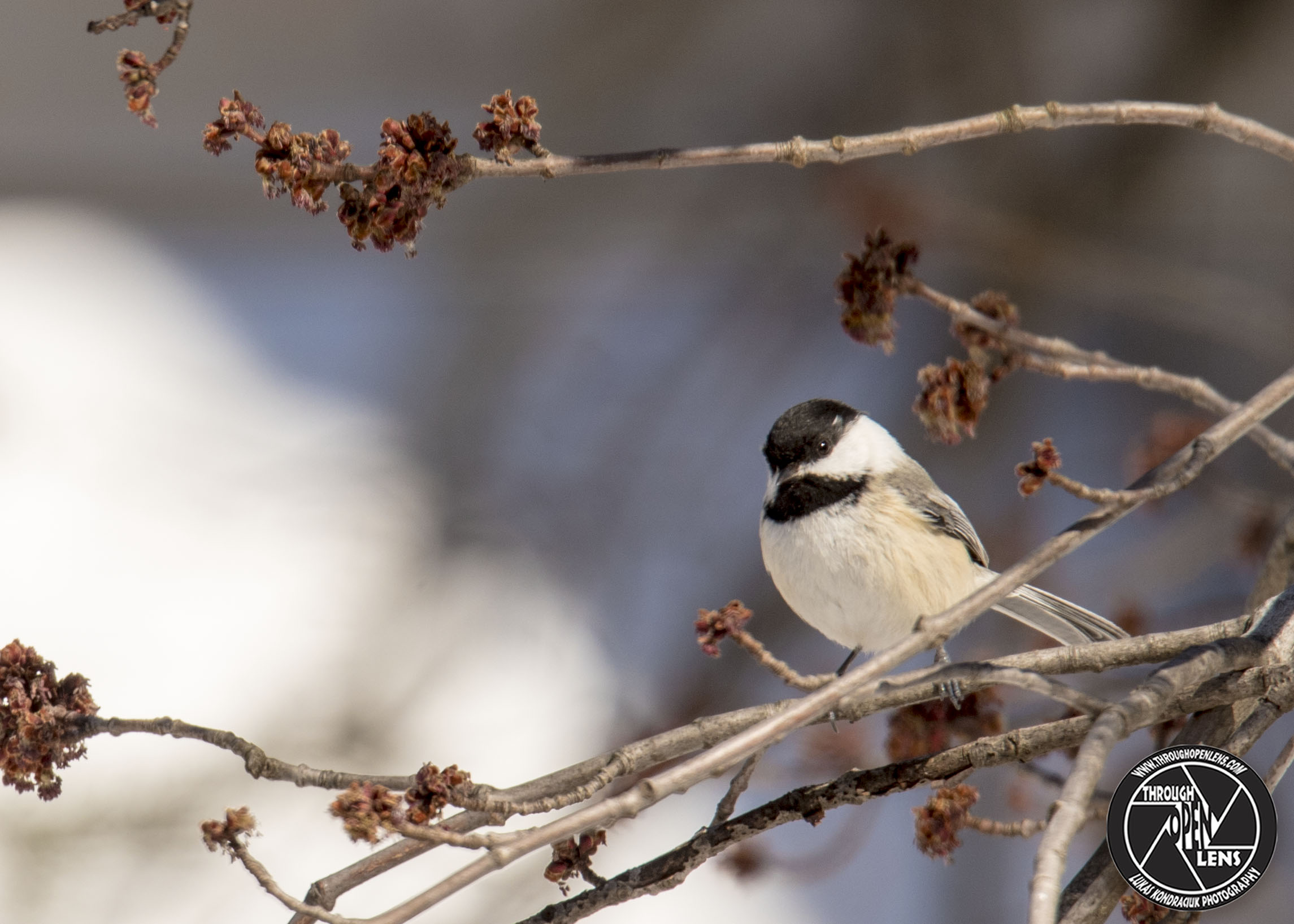
No Matter How Long The Winter, Spring Is Sure To Follow!

F/10.0, 1/400, ISO 160.

Black-capped Chickadee

What did the tree say to spring?

What a re-leaf.

Interesting Fact: Chickadee calls are complex and language-like, communicating information on identity and recognition of other flocks as well as predator alarms and contact calls. The more dee notes in a chickadee-dee-dee call, the higher the threat level. ( https://www.allaboutbirds.org/guide/Black-capped_Chickadee/lifehistory )

I Know You Are Jealous Of My Beak

F/8.0, 1/250, ISO 320.

Northern Shoveler ( Female ) 

How do you know if there’s a snowman in your bed?

You wake up wet!

Interesting Fact: Northern shovelers feed by dabbling for plant food, often by swinging its bill from side to side and using the bill to strain food from the water. They use their highly specialized bill (from which their name is derived) to forage for aquatic invertebrates – a carnivorous diet. Their wide-flat bill is equipped with well-developed lamellae – small, comb-like structures on the edge of the bill that act like sieves, allowing the birds to skim crustaceans and plankton from the water’s surface. This adaptation, more specialized in shovelers, gives them an advantage over other puddle ducks, with which they do not have to compete for food resources during most of the year. Thus, mud-bottomed marshes rich in invertebrate life are their habitat of choices. ( https://en.wikipedia.org/wiki/Northern_shoveler#Behavior )

Bring On The Night!

jersey-city-downtown-park

F/18.0, 24.0, ISO 80.

Newport Green Park Downtown Jersey City

A man asked his wife what she’d like for her birthday. “I’d love to be six again,” she replied.
On the morning of her birthday, he got her up bright and early and off they went to a local theme park.
What a day! He put her on every ride in the park: the Death Slide, the Screaming Loop, the Wall of Fear, everything there was!
Wow! Five hours later she staggered out of
the theme park, her head reeling and her stomach upside down.
Right to a McDonald’s they went, where her husband ordered her a Happy Meal with extra fries and a refreshing chocolate shake.
Then it was off to a movie, the latest Star Wars epic, a hot dog, popcorn, Pepsi, and M&Ms.
What a fabulous adventure! Finally she wobbled home with her husband and collapsed into bed.
He leaned over and lovingly, asked, “Well, dear, what was it like being six again?”
One eye opened. “You idiot, I meant my dress size.”
The moral of this story: Even when the man is listening, he’s still gonna get it wrong.

Interesting Fact: Newport is a 600-acre (2.4 km2) master-planned, mixed-use community in Downtown Jersey City, New Jersey, United States, consisting of retail, residential, office, and entertainment facilities. The neighborhood is situated on the Hudson Waterfront opposite the Tribeca area of Lower Manhattan in New York City, on what had been the yards of Erie Railroad‘s Pavonia Terminal. Redevelopment of the neighborhood began in 1986 as a $10 billion project led by real-estate tycoon Samuel J. LeFrak and his firm The LeFrak Organization.  ( https://en.wikipedia.org/wiki/Newport,_Jersey_City )