Wazzaap!

F/6.3, 1/145, ISO640.

Turkey Vulture ( Juvenile )

Why are hairdressers never late for work?

Because they know all the short cuts!

Interesting Fact: Outside of the breeding season, Turkey Vultures form roosts of dozens to a hundred individuals. When Turkey Vultures court, pairs perform a “follow flight” display where one bird leads the other through twisting, turning, and flapping flights for a minute or so, repeated over periods as long as 3 hours. Migrating flocks can number in the thousands. At carcasses, several Turkey Vultures may gather but typically only one feeds at a time, chasing the others off and making them wait their turn. Despite their size, Turkey Vultures are often driven off by smaller Black Vultures, Crested Caracaras, Zone-tailed Hawks, and other species. ( https://www.allaboutbirds.org/guide/Turkey_Vulture/lifehistory )

Friday Is My Second Favorite F Word My First Is FOOD Definitely FOOD!

F/11.0, 1/500, ISO 320.

Blue-gray Gnatcatcher

Where does a tree store their stuff?

In there Trunk!

Interesting Fact:  The Blue-gray Gnatcatcher’s grayish coloring and long tail, as well as the way it mixes snippets of other birds’ repertoires into its own high, nasal songs, have earned it the nickname “Little Mockingbird.” ( https://www.allaboutbirds.org/guide/Blue-gray_Gnatcatcher )

Just Act Weird It Keeps The Creeps Away!

F/11.0, 1/500, ISO 200.

Snowy Egret

Why did the scarecrow win an award?

Because he was outstanding in his field.

Interesting Fact: Adult Snowy Egrets have greenish-yellow feet for most of the year, but at the height of the breeding season their feet take on a much richer, orange-yellow hue. The bare skin on their face also changes color, from yellow to reddish. ( https://www.allaboutbirds.org/guide/Snowy_Egret )

I Am On A Seafood Diet. I See Food, And I Eat It.

F/ 6.3, 1/80, ISO 640.

Turkey Vulture

Two vultures are in a field, eating a dead clown.

One vulture says to the other, “Does this taste funny to you?”

Interesting Fact:  Turkey Vultures nest in rock crevices, caves, ledges, thickets, mammal burrows and hollow logs, fallen trees, abandoned hawk or heron nests, and abandoned buildings. These nest sites are typically much cooler (by 13°F or more) than surroundings, and isolated from human traffic or disturbance. While they often feed near humans, Turkey Vultures prefer to nest far away from civilization. ( https://www.allaboutbirds.org/guide/Turkey_Vulture/lifehistory )

PhotoBomb!

F/13.0, 1/400, ISO 500.

Black Scoter 

Why did the belt go to jail?

Because it held up a pair of pants!

Interesting Fact:  The Black Scoter is among the most vocal of waterfowl. Groups of Black Scoters often can be located by the constant mellow, plaintive whistling sound of the males.  ( https://www.allaboutbirds.org/guide/Black_Scoter )

We Are All Winging it!

F/5.6, 1/2000, ISO 320.

Anna’s Hummingbird ( Female )

Why do bees have sticky hair?

Because they use honeycombs.

Interesting Fact: Hummingbirds are strictly a New World animal. They fascinated the first Europeans who arrived on the continent. Christopher Columbus wrote about them and many wondered if they were a cross between a bird and an insect (at one point being called “flybirds”). Later, their feathers became fashionable ornaments in Europe (a practice that has thankfully fallen out of favor). ( https://www.allaboutbirds.org/guide/Annas_Hummingbird/overview )

I Swear, I Am One Cocktail Away From Telling Everyone What I Really Think!

F/8.0, 1/250, ISO 160.

Least Sandpiper

A Sandwich walks into a bar.

The bartender says “Sorry, we don’t serve food here”

Interesting Fact: Researchers studying Least Sandpipers discovered a new feeding mechanism. While probing damp mud with their bills, the sandpipers use the surface tension of the water to transport prey quickly from their bill tips to their mouths. ( https://www.allaboutbirds.org/guide/Least_Sandpiper/ )

Pit Stop

F/10.0, 1/400, ISO 250.

Butterfly

A boy and his father were playing catch in the front yard when the
boy saw a honey bee. He ran over and stomped it.

“That was a honey bee,” his father said,”one of our friends, and for
stomping him you will do without honey for a week.”

Later the boy saw a butterfly so he ran over and stomped it.
“That was a butterfly,” his father said, “one of our friends, and for
stomping him you will do without butter for a week.”

The next morning the family had sat down for breakfast. The boy ate
his plain toast (no honey and butter.)

Suddenly a cockroach ran from under the stove. His mother stomped it.
The boy looked at his father and said, “Are you going to tell her or
should I?

Interesting Fact:  Butterflies are insects in the clade Rhopalocera from the order Lepidoptera, which also includes moths. Adult butterflies have large, often brightly coloured wings, and conspicuous, fluttering flight. The group comprises the large superfamily Papilionoidea, along with two smaller groups, the skippers (superfamily Hesperioidea) and the moth-butterflies (superfamily Hedyloidea). Butterfly fossils date to the Palaeocene, about 56 million years ago. ( https://en.wikipedia.org/wiki/Butterfly )


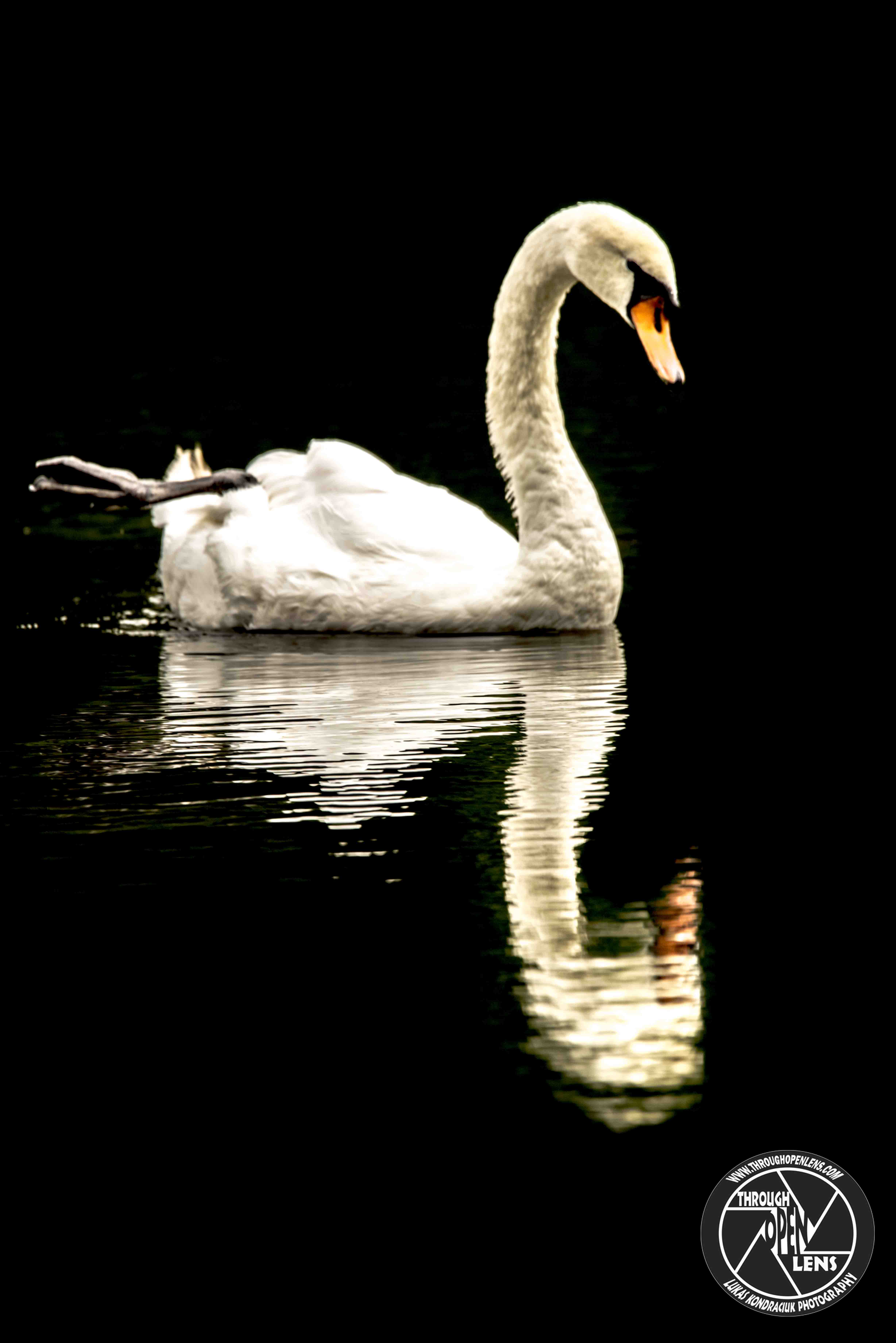
The Darkness That Surrounds Us Cannot Hurt Us. It Is The Darkness In Your Own Heart You Should Fear.

F/9.0, 1/320, ISO 320.

Mute Swan

Why did The Joker have to sleep with his lights on?

Because he was afraid of the Dark Knight.

Interesting Fact: Short legs placed well back on the body give Mute Swans an awkward walking gait, but the birds can run quickly if pursued and can take off from land and water, flying with head and neck extended. On the water they sometimes hold their wings slightly raised and “sail” with the wind. ( https://www.allaboutbirds.org/guide/Mute_Swan/lifehistory )

Do We Have A Problem Here!

F/6.3, 1/640, ISO800.

American Black Duck

What says “Quick, Quick”?

A duck with the hiccups.

Interesting Fact: If a mother is killed or separated from her brood, another Black Duck with ducklings of her own, regardless of their age, will quickly adopt the orphans. ( http://identify.whatbird.com/obj/392/_/American_Black_Duck.aspx )