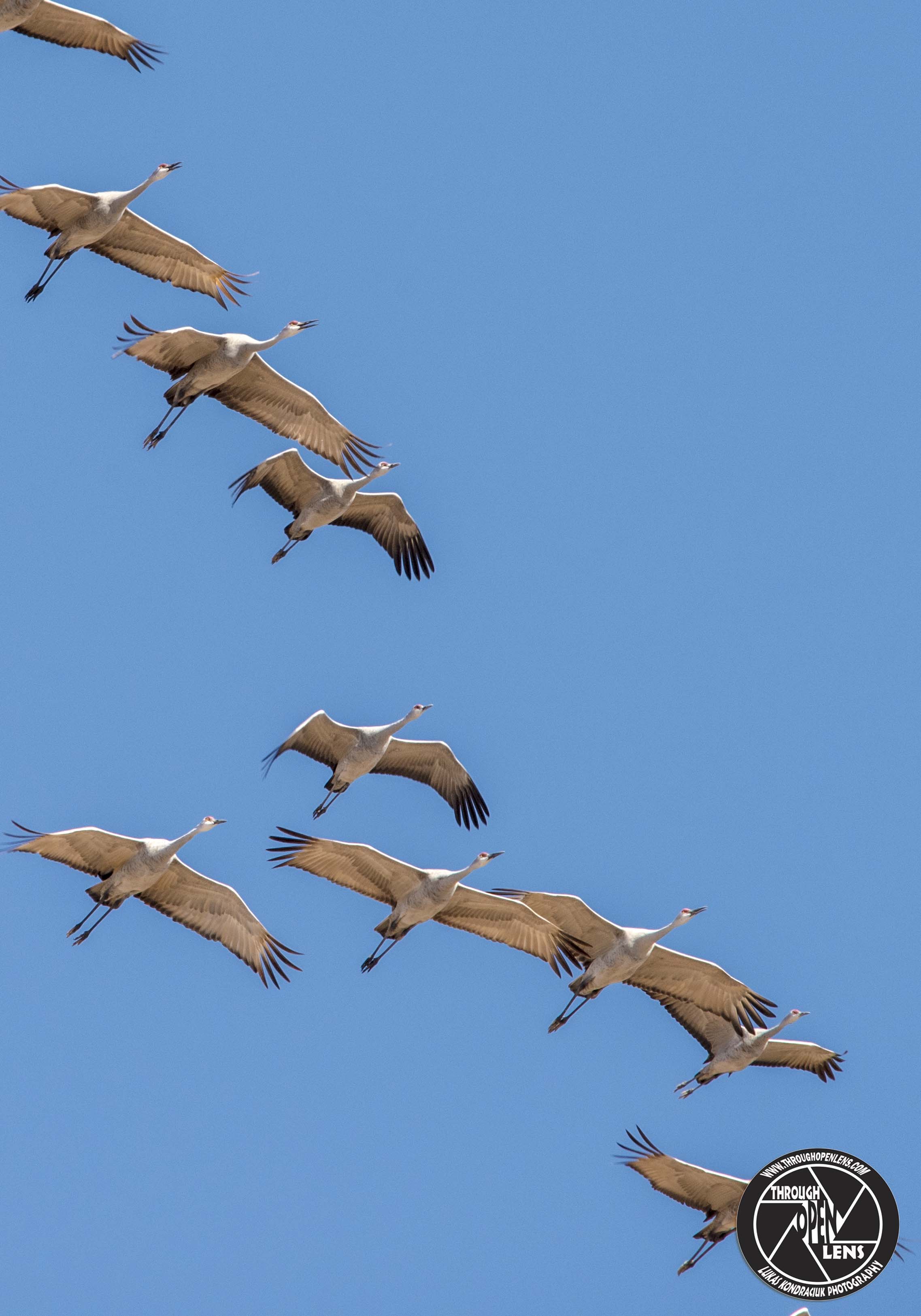
Let’s Get Into Formation!

F/10.0, 1/400 ISO 320.

Sandhill Cranes 

Did you hear the one about the roof?

Never mind, it’s over your head.

Interesting Fact: Sandhill Cranes mate for life, choosing their partners based on dancing displays. Displaying birds stretch their wings, pump their heads, bow, and leap into the air. Although each female usually lays two eggs, only one nestling typically survives to fledge. Mated pairs and their juvenile offspring stay together all through the winter, until the 9- to 10-month-old juveniles finally separate from their parents the following spring. ( https://www.allaboutbirds.org/guide/Sandhill_Crane/lifehistory )

I Am Going Green!

F/6.3, 1/125, ISO 320.

American Wigeon

A man takes his dog to the vet.

“My dog is cross-eyed, is there anything you can do for him?”

“Well,” said the vet, “let’s have a look at him” So he picks the dog up and examines his eyes, then he checks his teeth.

Finally, he says, “I’m going to have to put him down.”

“What? Because he’s cross-eyed?”

“No, because he’s really heavy”.

Interesting Fact: The American Wigeon is a rare, but regular straggler to Europe where it turns up in flocks of Eurasian Wigeon. ( https://www.allaboutbirds.org/guide/American_Wigeon/lifehistory ).

Shouting Out The Wrong Part Of The Song With Confidence!

F/7.1, 1/200, ISO 320.

Ovenbird

A wife told her husband to whisper dirty things to her, the husband then replies,

“The kitchen, the living room, the conservatory and the dining room.”

Interesting Fact: On its breeding ground, the Ovenbird divides up the forest environment with the other warblers of the forest floor. The Ovenbird uses the uplands and moderately sloped areas, the Worm-eating Warbler uses the steep slopes, and the Louisiana Waterthrush and the Kentucky Warbler use the low-lying areas. ( https://www.allaboutbirds.org/guide/Ovenbird/lifehistory )

If You Can’t Reach It You Don’t Need It!

F/10.0, 1/400, ISO 400.

Pileated Woodpecker

How are a husband and a cat similar when it comes to housework?

They both hide when they see the vacuum cleaner.

Interesting Fact: The feeding excavations of a Pileated Woodpecker are so extensive that they often attract other birds. Other woodpeckers, as well as House Wrens, may come and feed there. ( https://www.allaboutbirds.org/guide/Pileated_Woodpecker )


Don’t Be Afraid To Stick Your Neck Out!

F/9.0, 1/320, ISO 100.

Mute Swan

What did one potato chip say to the other?

Shall we go for a dip?

Interesting Fact: Short legs placed well back on the body give Mute Swans an awkward walking gait, but the birds can run quickly if pursued and can take off from land and water, flying with head and neck extended. On the water they sometimes hold their wings slightly raised and “sail” with the wind. Mute Swans are predominantly monogamous and form long-lasting breeding pairs. They are extremely aggressive in defending their breeding territory. ( https://www.allaboutbirds.org/guide/Mute_Swan/lifehistory )

I Forgot My Swimsuit!

F/5.6, 1/500, ISO 200.

Horned Grebe

What do you get when you’re on you hands and knees?

You get very dirty.

Interesting Fact: A sleeping or resting Horned Grebe puts its neck on its back with its head off to one side and facing forward. It keeps one foot tucked up under a wing and uses the other one to maneuver in the water. Having one foot up under a wing makes it float with one “high” side and one “low” side. (https://www.allaboutbirds.org/guide/Horned_Grebe/overview# ).


If Things Were Easy To Find, They Wouldn’t Be Worth Finding!

F/10.0, 1/400, ISO 250.

Sandhill Cranes 

What’s the secret to telling a good postman joke?

It’s all in the delivery

Interesting Fact: Sandhill Crane chicks can leave the nest within 8 hours of hatching, and are even capable of swimming. ( https://www.allaboutbirds.org/guide/Sandhill_Crane )

How Is My Posture?

F/6.3, 1/125, ISO 320.

Ruby-crowned Kinglet 

Why did the skeleton go to the BBQ?

To get some spare ribs!

Interesting Fact:  Breeding pairs of Ruby-Crowned Kinglets stay together for two months, until their chicks fledge. Ruby-Crowned Kinglets use their long, bubbly, and amazingly loud songs to establish territories; this is more energy efficient than chasing and less dangerous than fighting. They can be recognized by a constant flicking of their wings. ( https://www.allaboutbirds.org/guide/Ruby-crowned_Kinglet/lifehistory )


The Juice Is Worth The Squeeze!

F/11.0, 1/500, ISO 320.

House Finch

What do you call a fake noodle?

An impasta.

Interesting Fact: A highly social bird, the House Finch is rarely seen alone outside of the breeding season, and may form flocks as large as several hundred birds. House Finches feed mainly on the ground or at feeders or fruiting trees. At rest, they commonly perch on the highest point available in a tree, and flocks often perch on power lines. ( https://www.allaboutbirds.org/guide/House_Finch/lifehistory )

Let’s Dance!

F/10.0, 1/400, ISO 320.

Greater Yellowlegs & Green-Winged Teal Duck ( Female ) 

Why did the Vampire get fired from the Blood Bank?

He was caught drinking on the job.

Interesting Fact: The Greater Yellowlegs walks with a distinctive high-stepping gait across wetlands when foraging, occasionally dashing forward in pursuit of a prey item. Compared to other shorebirds, the Greater Yellowlegs is often rather solitary. ( https://www.allaboutbirds.org/guide/Greater_Yellowlegs/lifehistory )